
Theatr Clwyd
The redevelopment of Theatr Clwyd demonstrates how a sensitive retrofit can transform a Grade II‑listed theatre into a low‑carbon, future‑ready cultural venue. Balancing heritage conservation with ambitious sustainability goals, the project reimagines a 1970s building as an accessible, high‑performance home for creative life in Wales.
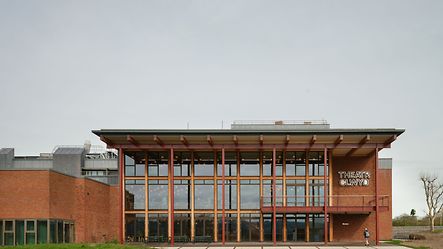
Architect: Haworth Tompkins
Façade contractor: Quality Glazing Solutions
Main contractor: Gilbert‑Ash
Photo credits: PHILIP VILE ART
Products: AWS 75.SI window system and ADS 75 HD.HI door system
Setting the stage for tomorrow
Since its opening in 1976, Theatr Clwyd has been a premier cultural institution in Wales and one of the leading producing theatres in Britain – a centre for performance, creative development and community engagement. Across nearly fifty years, the theatre has delivered locally produced drama, touring work and community arts programmes. The venue has been key in promoting social, educational and economic activity in North-East Wales, as well as attracting tens of thousands of visitors annually.
By the early 2020s, however, the original building was showing the limitations typical of its era. Although the theatre was still operational, the structure had become outdated, thermally inefficient and increasingly unable to support modern performance and public expectations. Key building systems and public areas no longer met contemporary standards of sustainability, comfort or accessibility. A comprehensive upgrade was therefore required to ensure Theatr Clywd’s long-term future.
Redevelopment objectives
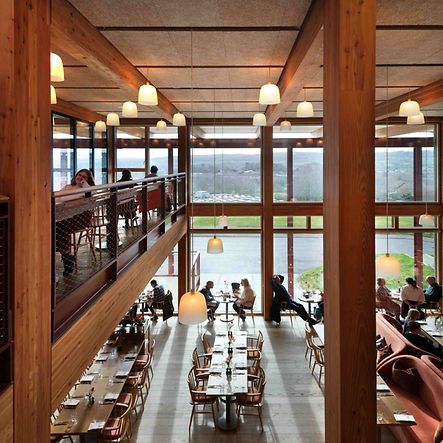
In response, Flintshire County Council – in partnership with Theatr Clwyd Trust, main contractor Gilbert-Ash and leading architectural studio Haworth Tompkins – embarked on a £50 million redevelopment programme to transform the theatre into a world-class venue for the next generation. The project involved fully refurbishing the existing structure and adding new sections, most notably a striking timber-framed foyer to enhance the connection between the interior space and the surrounding landscape.
At the core of the design strategy was a commitment to sustainability, energy efficiency and long-term affordability. The redevelopment aimed to significantly reduce energy consumption, target carbon neutrality and create a building that met the highest environmental standards. This included equipping the theatre with air-source heat pumps, rainwater harvesting, extensive photovoltaic systems, as well as green roofs and walls, to make it among the UK’s most sustainable cultural buildings.
Key challenges
The scale, ambition and context of the project presented several major challenges. Firstly, the need to retain, but also renovate elements of a Grade II-listed building required careful planning. This involved stripping the theatre back to its core shell and upgrading the thermal envelope to meet modern standards, whilst keeping the original building fabric where appropriate.
Enhancing energy performance was a second significant challenge. Achieving high levels of airtightness, insulation and passive performance when refurbishing an existing building demands solutions that go beyond typical renovation work, including exacting specifications for façade systems and building envelope components that must deliver technical performance, whilst also fulfilling the aesthetics of the architectural design.
Thirdly, accessibility and operational flexibility were important considerations. Modern cultural venues must serve a range of different users, from audiences and community groups to technical crews. Barrier-free access to facilities throughout, improved circulation spaces, plus adaptable performance and rehearsal rooms, all required close collaboration between the design teams, contractors and specialist systems suppliers.
Schüco delivers high performance
Specialist contractor Quality Glazing Solutions Limited used Schüco for the building envelope because of the high-performance criteria demanded. Schüco AWS 75.SI windows and Schüco ADS 75 HD.HI doors were the primary solutions for the theatre’s glazed areas. These products provide outstanding thermal insulation, helping to achieve the ambitious energy targets. A theatre also places particular demands on acoustic performance and these Schüco systems offer strong acoustic insulation properties too.
In addition, Schüco products were selected for their design flexibility and durability. The slim sightlines and high-quality finish support the architectural vision of allowing generous natural light inside and connecting the building to the landscape outside. The window system enables automated ventilation where required for passive and active climate control strategies, whilst the low-maintenance Schüco ADS 75 HD.HI doors offer robust performance in high-traffic conditions, which is critical for a busy public building.
Outcome and benefits
The redeveloped Theatr Clwyd represents a very significant upgrade on the previous building. Public areas are now more welcoming, spacious and connected to the surrounding environment. Accessibility has been comprehensively improved with barrier-free access, lifts and facilities for all audiences. The backstage and technical spaces have been reorganised and modernised.
In terms of sustainability, the theatre is no longer reliant on fossil fuels; it has cut operational carbon emissions, reduced utility costs and now provides a built environment that models best practice for theatres and cultural buildings across the UK. Enhanced thermal performance and the high efficiency of the products used in the building envelope contribute directly to these targets, delivering long-term value for the client.
The Theatr Clwyd redevelopment not only secures the future of this vital cultural institution, but it also demonstrates how heritage buildings can be transformed to meet environmental, social and economic requirements. Thanks to thoughtful design, high-performance construction and high-quality products, the theatre stands as a landmark for sustainable cultural infrastructure, ready to serve its community for decades to come.
