
Designing curtain walling to deliver occupant thermal comfort
Stephen Newell, National Specification Manager at Schüco explores some of the measures that can be incorporated into curtain walling to deliver occupant thermal comfort.
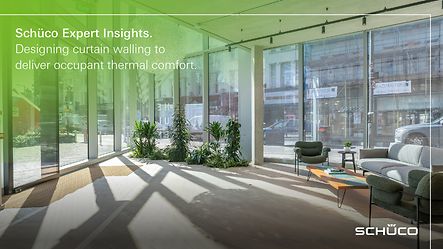
The building façade is key to maintaining thermal comfort in indoor workplaces. When people are dissatisfied with their thermal environment it impacts their ability to function effectively and their satisfaction at work, it can even impact their health.
The starting point in developing a curtain wall solution to deliver a comfortable thermal environment for both new build and retrofit schemes is to limit heat losses through the façade. Using SchüCal software, Schüco can adapt elements of a façade system, such as the glazing specification, to enable a façade to deliver the thermal performance required. Whatever the adaptations, the Building Regulations specify a maximum permissible heat loss which is a U-value 0.26 W/(m2.K) for a wall or 1.6W/(m2.K) for a window.
In addition to preventing heat losses, the façade is also important in limiting heat gains. Generally, the challenge with commercial buildings is to achieve a balance between large, glazed areas, to allow natural light to enter a space to reduce demand for artificial lighting, while limiting the amount of solar heat energy that can also enter which could lead to a space becoming too hot.
On commercial buildings in particular, the building services consultant will often specify the performance criteria a façade should deliver to maintain occupant thermal comfort. Sometimes an engineer will be even more specific and provide maximum heat gain and/or loss criteria for each elevation.
Schüco partners work closely with their glass suppliers. They can, for example, have coatings and films applied to the glazing to help limit solar thermal transmission.
Thermal comfort for occupants can also be enhanced by adding shading to windows, by keeping direct sunlight off individual workspaces and through the provision of fresh air.

Brise Soleil

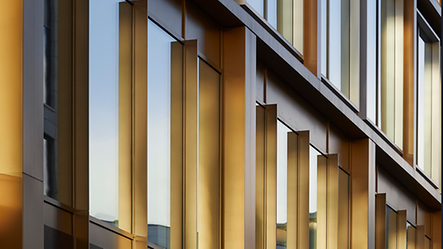
Shading to windows can be provided by brise soleil. These can be used to prevent high-angle summer sun entering the building through the windows while, at the same time, allowing low-angle winter sun to enter a space to enable it to benefit from passive solar heat in winter.
Some brise soleil systems, such as Schüco Aluminium Louvre Blades, can be integrated into curtain walling. The louvre blades can be arranged horizontally and/or vertically to ensure highly effective shading at any time of the day or year. A wide range of louvre blades and cantilever brackets allow the system to be attached to Schüco window and façade constructions. Third party brise soleil can also be integrated into the façade using the same brackets.
While brise soleil are helpful in reducing solar gains, specifiers need to understand that brise soleil can also lead to an increase in heat losses in winter because the units can act like giant heat sinks attached to the outside of a building. Schüco undertook a study on this issue about three years ago. The study found that even though the brackets are thermally broken, the increased heat losses from the addition of brise soleil could be sufficient to impact a scheme’s compliance with Building Regulations.
Blinds

External blinds, fixed to the outside of a building, are an alternative to louvres to limit heat gains and keep direct sunlight off individual workspaces. Blinds made with extruded aluminium blades can help reduce solar gain and glare on sunny days and can be rolled up on days when then sun refuses to shine. The Schüco FWS 50 and 60 façade systems have the option to attach an external blind which, when closed, still offers a high level of transparency to enable users to retain a link to the outside world.
Textile external roller blind systems, such as Schüco AB ZDS, are another option to reduce heat gains to maintain occupant thermal comfort. The textiles are weather resistant and are stable in strong winds. Blinds can even be individualised with different fabrics and colours to complement a particular application.
More discreet shading and glare protection to provide thermal comfort can be achieved using an internal roller blind solution such as the Schüco Integralmaster. This provides a reduction in glare of up to 97% and a reduction in energy irradiation of up to 85%, which meets all national and EU guidelines on glare protection for workstations.
The Integralmaster system is designed to be fully integrated into all Schüco Aluminium Window Systems, without the need for bulky cassettes or lateral guides, which helps minimise impact on the interior aesthetics. This adaptable system enables different film and textile blinds to be combined to deliver sun shading, glare protection, screening and even improved thermal insulation.
Designers can also combine the Integralmaster with an external sun shading system, such as brise soleil, to give them much greater freedom in minimising both heat gains and tackling glare without the need to reduce the glazed area.
Fresh Air
Alongside minimising heat gains, thermal comfort is also impacted by air movement and ensuring sufficient fresh air supply for the number of occupants.
The simplest way to increase air movement is to open windows. This can be done manually or automatically using actuators such as Schüco TipTronic SimplySmart technology. These units feature a quiet mechatronic actuator that will work with almost all Schüco window systems and, when integrated into the building management system, the actuators can offer a wide range of opening options including crack ventilation, timed ventilation and night-time cooling.
A more sophisticated decentralised window-integrated ventilation system is the Schüco VentoTherm Twist. This system incorporates air quality sensors to deliver the ideal indoor climate. VentoTherm Twist can be incorporated into Schüco aluminium windows to provide controlled, room-specific ventilation with heat recovery but without the need to open a window.
The VentoTherm units supply fresh air by means of the two integrated ventilator modules incorporated into each unit. The modules alternate in operation. Vitiated air from within the space is drawn through one ventilator module where it is filtered, heat is extracted from it in the heat storage unit, before the now cooler air is expelled to outside.
At the same time, outside air is drawn through a second ventilator module. Here, it is warmed by heat in the heat storage unit, tempering the air before it is supplied to the room. VentoTherm Twist automatically switches the direction of air flow through the ventilator modules at regular intervals to enable the heat storage unit to be recharged.
These are just some of the options available to designers when developing façade solutions to deliver occupant thermal comfort.
For more information on Schüco curtain walling systems go to https://www.schueco.com/uk/specifiers/products/facades
