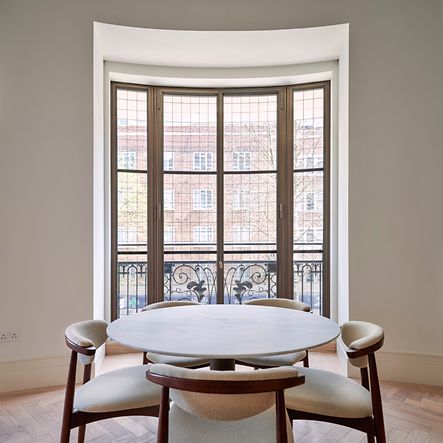
The Whiteley: adaptive reuse at its most ambitious
The Whiteley is the centrepiece of a landmark regeneration scheme breathing new life into a Grade II listed former department store.
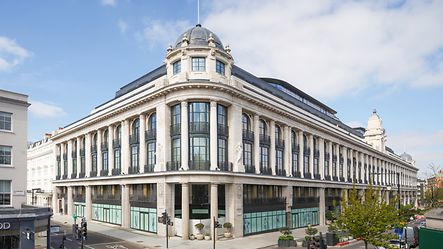
Architect: Foster + Partners
Façade Contractor: Propak Architectural Glazing Ltd
Main Contractor: Laing O’Rourke
Photo credits: Tim Fisher
Products: Jansen VISS curtain walling; Janisol Arte 66 windows; Janisol Arte 2.0 windows; Janisol doors
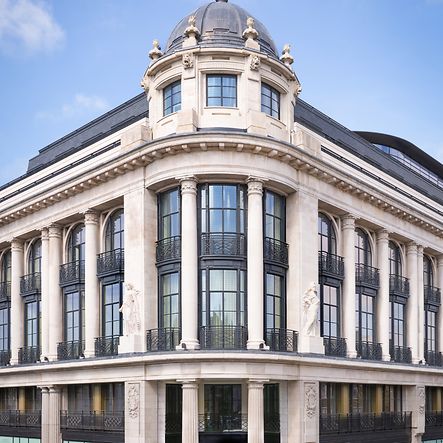
The Whiteley is a re-imaging of an historic art-deco department store on an epic scale in London's Bayswater.
Key to the scheme is the building’s Grade II listed retained façade. This has been fully restored using Schüco Janisol windows. Behind it, architect Foster + Partners has devised a mixed-use scheme comprising 139 private residential apartments and townhouses, a hotel and spa, restaurants, a new retail arcade, a cinema, gym and new public spaces.
The architectural design also includes the creation of a new cupola on the façade's north-east corner in-keeping with the original architect's vision for a symmetrical building. This now mirrors the one existing on the south-east corner. The façade has also been subtly remodelled, including relocation of the original 1912 entrance and magnificent central staircase, now seamlessly incorporated into the new hotel. A new main entrance has also been introduced as the centrepiece of the scheme.
To enable the façade’s transformation Propak Architectural Glazing conducted a detailed survey to enable it to understand which elements of the original 167 steel windows could be retained, conserved and restored. The survey revealed which elements would need to be replaced or remodelled to meet the demands of the architect's vision for the site and 21st-century standards of energy efficiency, safety and acoustic performance.
The original windows were found to be beyond repair, so Propak set about replicating these windows using Jansen steel window profiles. The replicas had like-for-like dimensions to ensure they remained faithful to the proportions of the originals while delivering excellent thermal and acoustic insulation. Each window was bespoke. Each aperture was surveyed using 3D laser scanning and the windows fabricated to fit precisely within tight tolerances. The windows also had to accommodate differential movement between the heritage façade and the new internal structure.
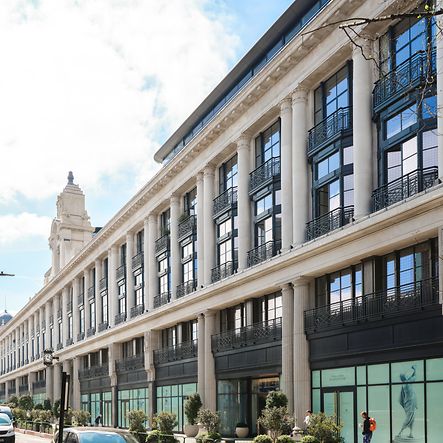
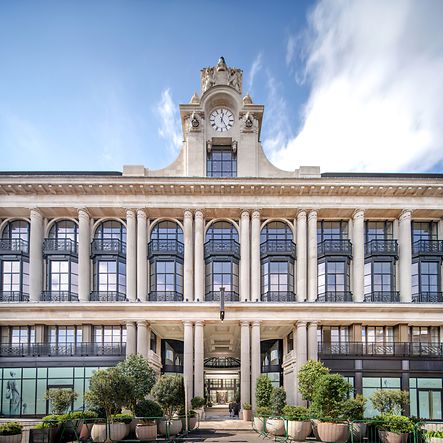
Working with Schüco, Propak adapted and enhanced the Janisol Arte 66 steel window system to produce thermally broken windows up to 4.3 metres high. The frames had to create ultra-slim sightlines - some as narrow as 25mm - to meet conservation requirements.
Where possible, Propak reclaimed and reintegrated the original cast iron mullions, fascia panels, balustrades and ironmongery into the new windows. In cases where salvage wasn’t feasible, 3D modelling and casting techniques were used to produce exact replicas of the originals.
New secondary steelwork had to be fabricated to support the new window assemblies and heritage fascia reclaimed from the original – the fascias alone weigh more than 500kg per window.
Custom reinforcements, including 10mm thick steel plates were laser-welded to the Jansen mullions, and add-on extrusions were developed to replicate the original detailing while delivering contemporary performance.
Analysis was also undertaken on the window frame paintwork. This had been layered over the years. Peeling back these layers revealed the original shade of grey from 1911, which was then colour-matched and applied to the new windows.
Unique fixing details were also created to accommodate the structural movement between the new steel windows and the new internal structure.
The upgraded window system underwent full-scale visual and performance testing in Switzerland, successfully meeting demanding benchmarks for air, wind, water, acoustic, and thermal performance.
The central glazed dome was also recreated with the same profile as the original, including replicating the same joints. However, the recreated dome is now located at a higher elevation than the original, above the new apartments, making it visible from across London.
Ultimately, this project demanded the highest levels of window design and precision craftsmanship. The result is a façade that looks original, performs like new, and stands as a case study in adaptive reuse excellence and, by enabling the original façade to be retained, the new windows also help reduce the scheme's embodied carbon.
The Whiteley won the Schüco Excellence Award for Refurbishment & Adaptive Reuse in 2025.