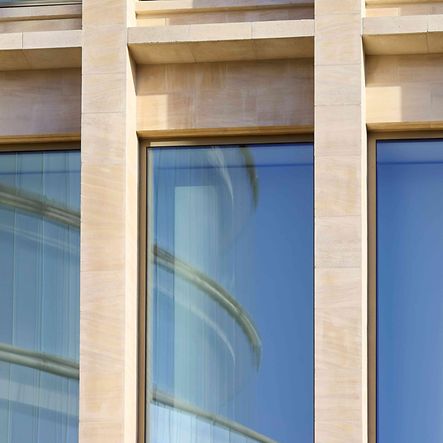
Stephen A. Schwarzman Centre
Schüco window and door systems are fundamental to enabling Passivhaus compliance of Oxford University’s latest building.
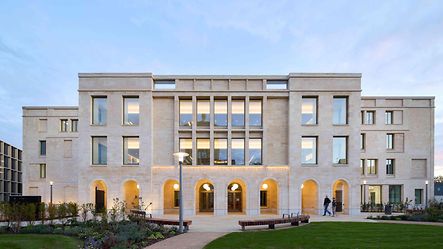
Architect: Hopkins Architects
Façade contractor: Britplas Facades
Main Contractor: Laing O’Rourke
Structural Engineer: AKTII
Building Services Engineer: Max Fordham
Photo credits: Hufton+Crow
Products: AWS 90 Super Insulated optimized; AD UP 90 SI
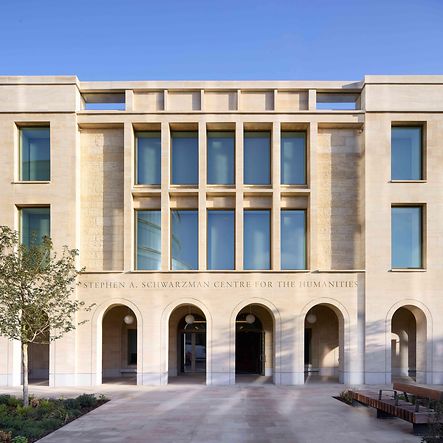
The Stephen A. Schwarzman Centre for the Humanities is the largest single building project ever undertaken by the University of Oxford.
The four-storey building brings together seven faculties and two research institutes and incorporates a 500-seat concert hall, a 250-seat theatre and a 100-seat cinema; in total the 25,000m2 building has over 1,000 rooms. It is also aiming for Passivhaus certification.
Schüco windows are fundamental to delivering the building’s Passivhaus performance. Hopkins Architects worked with Schüco early in the design development to select the most appropriate window for the scheme.
The architect was looking for a thermally efficient, Passivhaus compliant window with bilateral symmetry for both fixed glazing and openable vents to allow natural ventilation.
The solution: Schüco AWS 90 Super Insulated Optimized windows. These units are triple glazed and feature a thermally efficient aluminium frame. "The Schüco Optimized system is Passivhaus-certified and more thermally efficient when compared to a standard profile," explains Stephen Newell, National Specification Manager, Schüco UK and Ireland.
The window units sit within the Clipsham limestone- and cream brickwork-clad façades. These are assembled from prefabricated units, which were manufactured off site at constructor Laing O'Rourke's prefabrication facility. They were delivered to site with the finished stonework and window units installed.
Prefabrication required the scheme design to be fully developed and coordinated in BIM to ensure precision across the design team. Early engagement with main contractor Laing O'Rourke and window designer, fabricator and installer Britplas Facades ensured a window mounting system was developed that would allow the project to benefit from the precision and speed fostered by modern methods of construction. "We had a series of technical review meetings with the design teams from Hopkins and Laing O’Rourke to discuss design and product options early in design development," says Andrew Harrison, Design Manager at Britplas Facades.
To fit the windows into the precast concrete panels, Britplas Facades based a team at Laing O'Rourke's prefabrication facility. Achieving Passivhaus standard at this scale required exceptional airtightness and watertightness. "100% of the pre-installed windows were CWCT Hose tested to ensure they performed as designed, prior to delivery to site," says Harrison. “The installation was then air pressure tested following site installation of the panels,” he adds.
Apart from the units on the ground floor, which do not open for security reasons, all windows are openable to allow natural ventilation when external conditions allow. Initially each unit was specified with a combination of fixed and opening lights. However, with this arrangement the frame surrounding the opening lights was slightly wider than the frame surrounding the fixed section. To ensure bilateral symmetry, Britplas Facades proposed a solution based on a Schüco double vent window with twin opening lights, but with the "fixed" side held closed using concealed shootbolts.
In addition to the windows Britplas Facades also installed Schüco AD UP 90 Super Insulated doors on the ground floor entrances.
The project began on site in February 2023. It opened to the academic community in October 2025. The public, however, will have to wait until April 2026 before they too can experience this exceptional building and its impressive range of facilities.