
Shorts Gardens
Schüco systems were key to the transformation of a historic building in the heart of London's Covent Garden. The result is a modern mixed-use destination that thoughtfully balances commercial, residential and retail spaces.
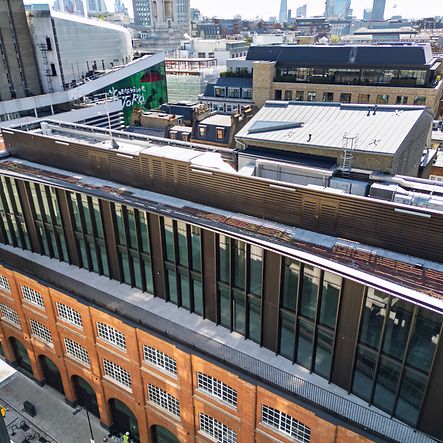
60-72 Shorts Gardens was originally constructed in the 1880s as a private electricity generating station. It was later used by the Ministry of Defence during the Second World War before being converted to office space.
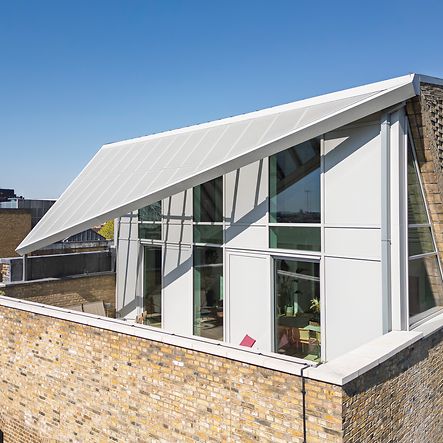
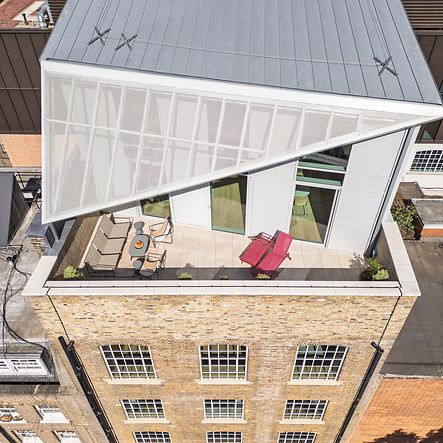
Developer SGLLP set out to breathe new life into the three-storey building. Architect Buckley Gray Yeoman's scheme revitalises the historic façade, adds a two-storey stepped-back extension to the roof and has opened the previously unused double-height basement, turning it into a contemporary workspace. To the rear of the building, a double-height retail unit fronts onto Betterton Street; above, five levels of residential apartments rise to a duplex with a private terrace, collectively accessed through a dedicated entrance and lobby.
This ambitious transformation required a façade capable of enhancing the building's character while meeting the complex technical demands of a contemporary redevelopment. Schüco systems were chosen for their performance and proven ability to integrate seamlessly with both contemporary and historic elements.
Visual harmony
Additionally, Janisol Arte 2.0 vertical pivot windows were used to replace existing Crittall windows, offering improved energy efficiency and visual harmony. The proximity of the neighbouring buildings meant that for fire protection, ADS 80 FR 60 fire-rated fixed lights and Janisol C4 EI60 steel fire-rated fixed lights maintain both safety and a consistent aesthetic.
The curtain walling systems were tailored to accommodate specific site conditions and design features such as the integration of window inserts behind hit-and-miss brickwork. This meets the project’s heritage requirements while enhancing energy efficiency and access to daylight.
The adaptability of these systems was crucial. Façades, for example, featuring corrugated perforated aluminium panels required curtain walling to be concealed behind them - an application demanding exceptional precision to maintain alignment, visual consistency, and system performance. Elsewhere, the integration of secondary steel framing, acoustic louvres, and bespoke solar‑shading assemblies relied on the dimensional accuracy and interface compatibility of the Schüco systems.
The scale, ambition and context of the project presented several major challenges. Firstly, the need to retain, but also renovate elements of a Grade II-listed building required careful planning. This involved stripping the theatre back to its core shell and upgrading the thermal envelope to meet modern standards, whilst keeping the original building fabric where appropriate.
Enhancing energy performance was a second significant challenge. Achieving high levels of airtightness, insulation and passive performance when refurbishing an existing building demands solutions that go beyond typical renovation work, including exacting specifications for façade systems and building envelope components that must deliver technical performance, whilst also fulfilling the aesthetics of the architectural design.
Thirdly, accessibility and operational flexibility were important considerations. Modern cultural venues must serve a range of different users, from audiences and community groups to technical crews. Barrier-free access to facilities throughout, improved circulation spaces, plus adaptable performance and rehearsal rooms, all required close collaboration between the design teams, contractors and specialist systems suppliers.
Retaining the original structure
This technical synergy allowed Vision Arch to deliver a façade that met the project’s stringent requirements for robustness, airtightness, structural stability, and acoustic separation, all within a historic envelope.
Sustainability was a defining objective of the redevelopment. Retaining much of the original structure significantly reduced embodied carbon. FWS 60.SI and AWS 75 BS.S systems further contributed to this goal with their low U‑values, reducing heat loss and supporting energy efficiency across the office, retail, and residential spaces.
In addition, the large-format glazing helps maximise natural light, reducing reliance on artificial lighting and enhancing occupant wellbeing. Bespoke solar shading frames, perforated panels, and high‑performance glazing mitigate solar gain, reduce cooling loads and improving comfort. The ASE 80.HI sliding doors and ADS 70.HG SG doors enable natural ventilation where appropriate, promoting healthier indoor environments. The result is a façade strategy that contributes meaningfully to the project’s operational performance while supporting long-term sustainability.
The completed redevelopment breathes new life into this significant Covent Garden site, delivering vibrant new workspaces, high-quality homes, and attractive retail units. Schüco systems were instrumental in achieving a façade that is technically advanced, visually refined, and sympathetic to its historic urban fabric.
