
Passivhaus performance from Schüco
Quarry House, a new build within the pit of a disused stone quarry, nestled between mature forest and open fields, required exceptional sensitivity to the surrounding environment and demanding Passivhaus standards of energy efficiency.
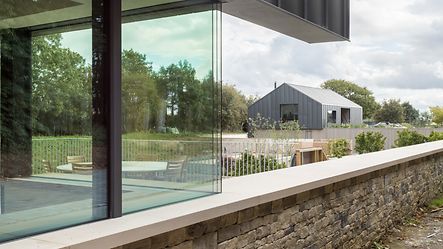
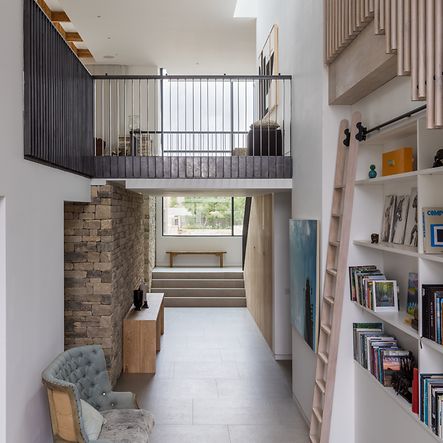
The house is partially below ground, so it was imperative to make as much use of natural light as possible without losing heat. Inside, a central double height atrium space is flanked by a series of private and semi-private spaces at two levels, each with their own view to the outside.
The project was granted permission under Paragraph 79 of the National Planning Policy Framework, which requires a proposal’s design to be ‘truly outstanding or innovative, reflecting the highest standards in architecture, and would help to raise standards of design more generally in rural areas.’
The design, by A-Zero Architects, uses materials local to the site – stone from the quarry and timber from the forest, with aluminium products from Schüco, to achieve the right blend of aesthetics and performance.
Schüco has developed a range of Passivhaus Institute certified, high-quality, high-performance windows, doors and façades. These feature a thermally broken aluminium alloy frame to ensure performance and functionality go hand-in-hand with sleek, elegant aesthetics. As with all Schüco doors, windows and façades, the frames can accommodate either double or triple glazed units.
Giles Bruce, Director at A-Zero Architects, explained: “Energy efficiency and thermal insulation are playing an increasingly important role in the design and construction of new building and renovation projects. We specified these aluminium products from the Schüco SI (Super Insulation) or HI (High Insulation) ranges over other systems as they are able to handle the many complex conditions that this project required, whilst meeting the performance and aesthetic requirements.”
The Passivhaus voluntary building performance standard for low energy buildings is an increasingly popular method for UK buildings, focusing on a 'fabric first' principle of constructing a building with a highly insulated and airtight envelope in order to reduce space heating demand to a very low level.
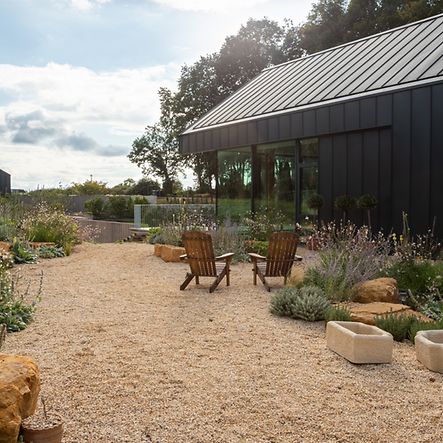
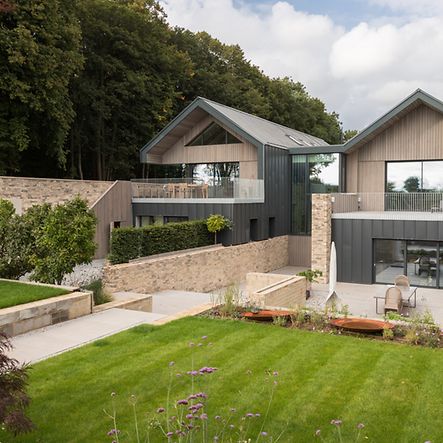
Although Passivhaus standards exceed those of the Building Regulations, it is down to the designer to decide how best to meet the criteria, which means Passivhaus buildings can be built using almost any construction method.
Key criteria that a Passivhaus scheme must meet are the following:
- The building must be airtight with less than 0.6 air changes per hour at a pressure of 50Pa.
- Space heating demand must not exceed 15kWh/m2/yr.
- Exterior walls must have a U-value less than 0.15 W/m2K,
- And the windows must be super-insulated with a U-value less than 0.8 W/m2K, which generally means they must be triple glazed, with a g-value of 50% to capture heat from the sun.
The range of Schüco systems specified work together to create a home that is designed with the objective of setting a low-energy standard.
Hershika Kerai, Business Manager at AumAxum Architectural Glazing, the fabricator for the project, commented: “To ensure that the large sliding doors that feature in this project were going to be as thermally efficient as they were stylish, ASE 80 HI from Schüco was the best option. The client wanted the doors to be extremely tall, however, the architect had to ensure the doors were of a height that had been thermally tested. The client visited our showroom and was immediately sold upon seeing the door.”
As the house is designed to Passivhaus standards, the energy required to keep it comfortable through the year does not exceed 15 kWh/m2. To put this into context, a standard Victorian house would use over 200 kWh/m2.
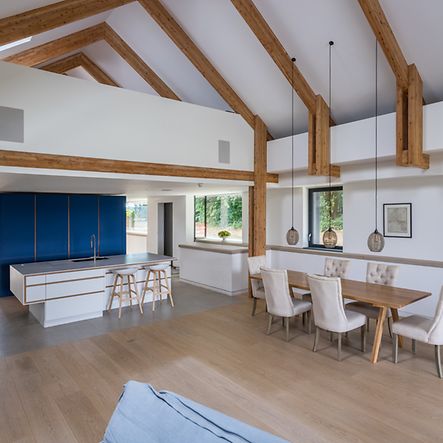
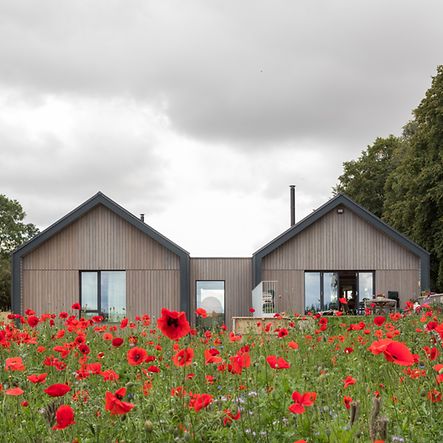
Giles explains: “This low space heating demand was achieved through high levels of insulation in the envelope, Cordex Filcor structural insulation below ground and a Pavatex wood wool insulation within the timber cassette construction, which forms the above ground envelope.
“All junctions within the construction were simulated to eliminate thermal bridging. The Schüco systems minimise heat loss in winter and solar gains in summer. Infiltration is minimised using a Pro Clima Intello Plus Vapour Check Membrane, and fresh air is provided mechanically, with all heat recovered from out-going air.”
A-Zero Architects is a RIBA chartered practice based in London. Founded in 2010, its work focusses on designing and procuring buildings in a way which does not have an adverse impact on the environment.
Aumaxum Architectural Glazing have over 20 years of experience in the Architectural Glazing Industry and are a Schüco Partner.
