Designing an award-winning façade for Oxford Street retrofit
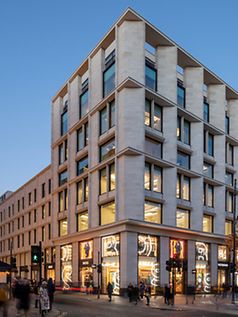
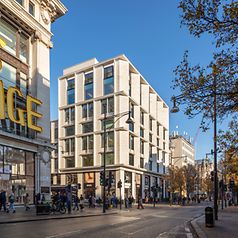
The Parcels Building is an ambitious retrofit scheme located in a prime location next to Selfridges on Oxford Street, London. Its innovative façade design and skilled execution secured the top prize, Overall Winner, at the Schüco Excellence Awards 2024.
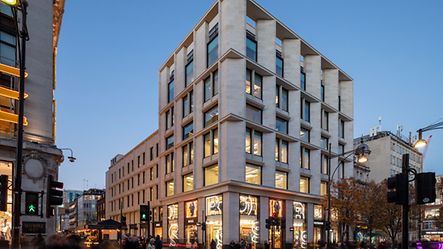
Architect: Grafton Architects (design) and tp bennett (delivery)
Specialist contractor: Structura
Photo credits: Nick Kane
Products: FWS 50, FWS 50 SG version, ADS 90.SI, GFT 50, ADS 70 doors
The goal was to modernise the building and improve its thermal and acoustic performance while echoing the aesthetic of its celebrated Grade II listed neighbour. The resulting building has received many architectural design accolades and its sustainability credentials are recognised with an Energy Performance Certificate (EPC) A and BREEAM Outstanding Certificate.
The refurbishment strategy was to retain the existing primary structure of the original 1950s building while wrapping its prominent elevations with a new façade and adding an additional storey.
A sustainable façade
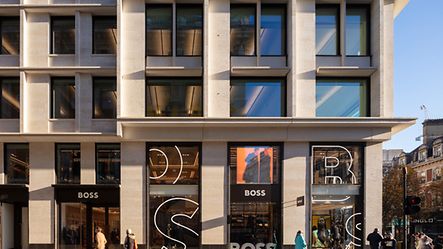
The new façade is constructed with Schüco FWS 50 curtain walling which sits behind handset Portland stone and pre-cast concrete elements. This gives the overall effect of windows from the outside of the building while providing the airtightness and thermal efficiency that comes with continuous curtain walling.
The new building envelope lets in much more natural light than the original façade while also greatly improving its energy efficiency. The U-value of the old façade was estimated to be 5 W/m²K while the new façade achieves 0.3 W/m²K for the walls and 1.4 W/m²K for the vision glazing, delivering substantial energy savings and improving occupant comfort.

Meeting complex design requirements
The façade design was complicated by structural issues that were uncovered during the retrofit, such as deteriorating concrete and non-compliant elements which required additional reinforcement. This called for a bespoke, highly engineered solution to be designed and extensively tested.
Manny Patel, CEO of Structura, the specialist contractor for the scheme, credits their early engagement through the Pre-Construction Services Agreement (PCSA) for the project’s success.
Manny explains: “The PCSA was key as it provided sufficient time in the programme for us to provide full-size mock-ups together with interface details and a choice of materials.”
Structura worked closely with the Schüco technical team to develop the right solution to meet the architect’s concept. Detailed 3D modelling in Revit helped streamline the design and construction process and the Structura team created a full-scale, six metre mock-up of the façade. This not only enabled Selfridges’ family owners to see it first hand to sign off the plans but also assisted Structura in developing the intricate interfacing with the stone façade.
“As a Schüco partner of over 30 years, Structura’s extensive knowledge of both curtain wall installation and fabrication ensured Schüco was our go-to system partner to solve the complex issues with such a complicated façade,” says Manny.
“This bespoke combination of façade types and systems proved complex. Each pre-cast panel weighed up to 5.5 tonnes and had to be tailored to fit the existing structure. The technical detail of attaching the new façade to the retained slabs took all our expertise and experience.”
The resulting ‘hugging’ brackets clamped the new stone to the structural columns and the curtain wall was developed to accommodate these passing through the system. The result is an elegant design that conceals the complexity of the solution.
A new London landmark
The installation of the façade also proved challenging due to the busy, highly pedestrianised nature of the Oxford Street location. With the largest glazed units weighing 500 kg a great deal of collaboration was required between the different contractors involved to be able to carry out the works safely and in the allotted timescale. Some of the installation work involved a full out-of-hours road closure over two weekends, so that a large mobile crane could be utilised.
The refurbished building is now worthy of its place on London’s most famous shopping street. The building’s rejuvenated appearance is testament both to the architect’s vision and to the expert contractors who worked together as a close-knit team. The Parcels Building stands as a shining example for revitalising outdated buildings.
Parcels Street
Nick Kane