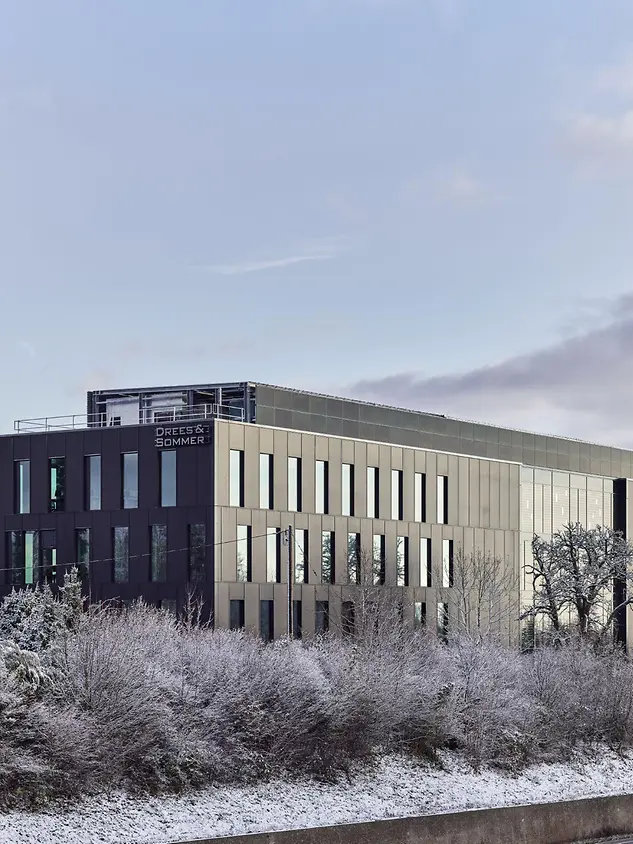
OWP 12

New office building with BIPV on the Drees & Sommer campus

With their own new office building Obere Waldplätze 12 in Stuttgart, known as OWP 12, Drees & Sommer has brought their business philosophy of "sustainable, digital, innovative, economic" to life and used lots of promising, futuristic technology from the construction industry to achieve this. OWP 12 was created using the newest planning and building methods in accordance with the Cradle to Cradle principle and it shows what energy-plus architecture can do today thanks to the slimline, high-performance façade with building integrated photovoltaics (BIPV) from Schüco.
Reference details

Type of Building Office and administration
Product areas Facades BIPV
Schüco Systems BIPV
Features New build Decarbonization Energy efficiency
Location Stuttgart, Baden-Württemberg
Completion 2021
Architects SCD Architekten Ingenieure GmbH
Specialist company FKN Fassaden
Picture credits © Juergen Pollak

OWP 12 – a green powerhouse

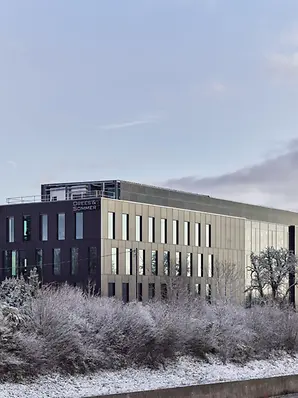
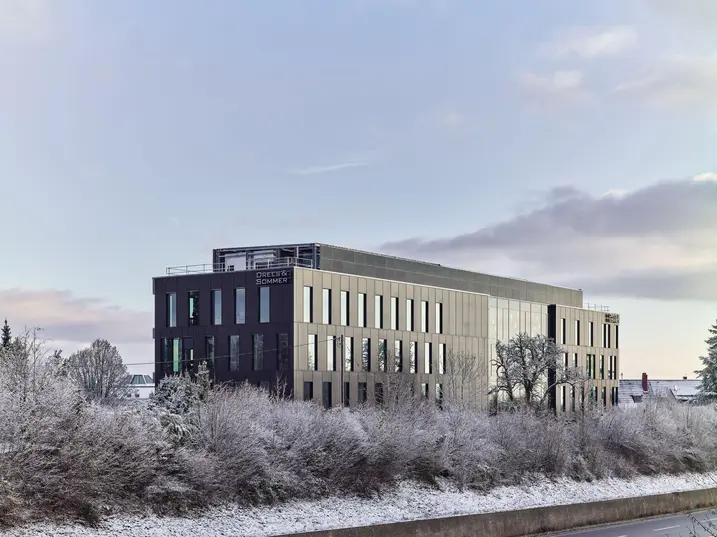
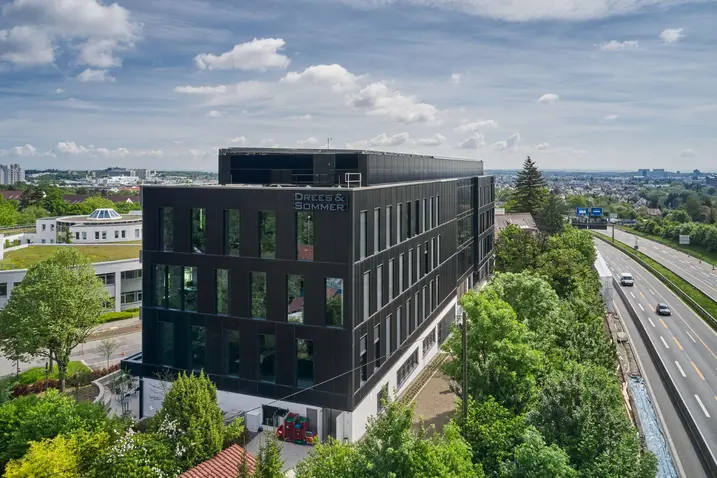
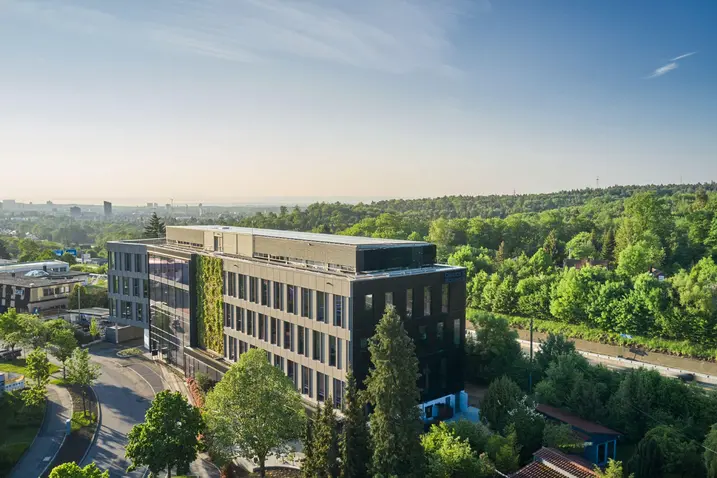
OWP 12 towers like a monolith over the A 831 just outside Stuttgart. With its compelling design the 20 metre wide and 70 metre long cuboid, designed by the Stuttgart based firm SCD Architekten Ingenieure GmbH, is truly eye-catching. In accordance with the client's sustainability requirements the building materials used in large parts of the building largely comply with the "Cradle to Cradle" concept. 

Schüco Showroom Berlin

BIM for sustainability and prefabrication

The building materials used in the project were documented in detail in a materials passport based on the BIM model. "With the BIM model we know exactly which module with which materials we built in which location. This digital memory is therefore also a basic prerequisite for greater sustainability," explained Johannes Wiesinger, a senior technical building services expert at Drees & Sommer. The digital planning also enabled a high level of prefabrication of the modular façade and a series module fabrication that saved time and costs. Despite its technical complexity, the entire façade of OWP 12 was installed in only two-and-a-half weeks. In total, OWP 12 took two years to build, cost 22 million euros and is a blueprint for efficient cross-trade collaboration in terms of a sustainable overall concept.

BIPV in transparent and opaque surfaces

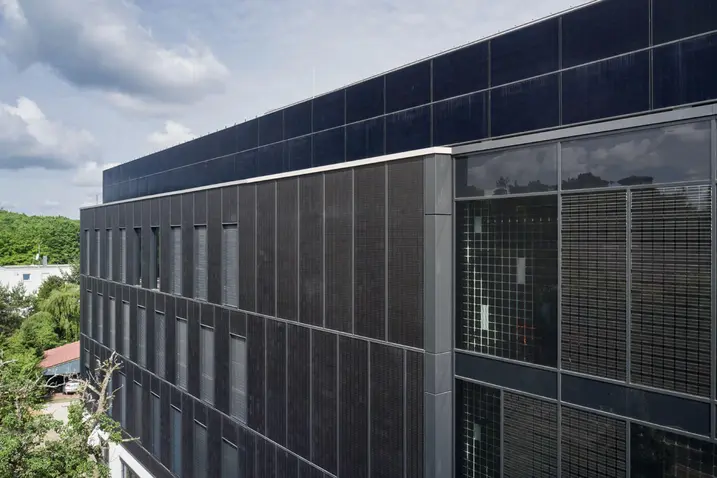
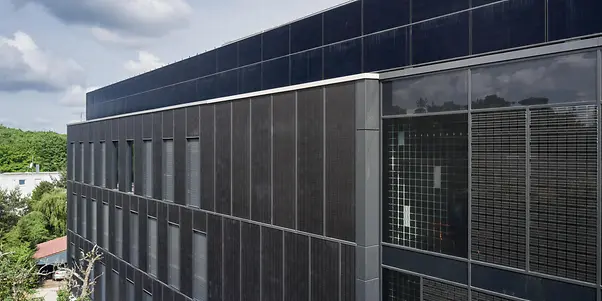
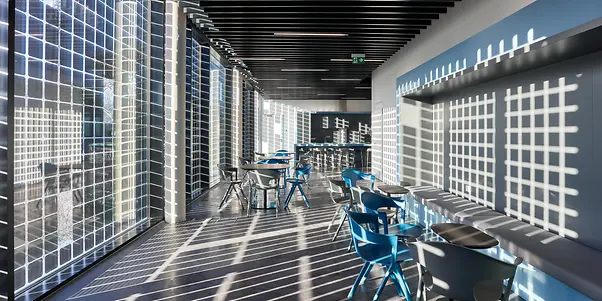
The Schüco BIPV, which is on almost 700 m² of the façade surface on the south and west sides of the building, has an output of around 70 megawatt hours per year. That is about 40 percent of the PV output. Both transparent, triple-glazed insulating glass BIPV modules with black monocrystalline cells and black monocrystalline BIPV glass-glass modules were used as opaque, foward-mounted units in front of the main façade. "The requirement to reduce the natural reflection of the PV modules along the motorway due to traffic safety concerns was a challenge," explained Marco Schech, the leading project engineer for BIPV at Schüco. "We then finally found a special cover glass which significantly reduced the reflection, thanks to its unusual surface structure, and fulfilled the official requirements." An interesting side effect is that the solar energy output through this special glass is actually 3% higher. 

Schüco Showroom Berlin

BIPV used as a design element

Schech is pleased that the niche topic of BIPV is currently gaining enormous momentum due to new political requirements and a rethink among clients and companies. BIPV is also growing in popularity amongst developers because building integrated photovoltaics nowadays enables even more interesting design effects and does not limit an architects creativity. "For the OWP 12 project the PV units had 32 different formats which is quite common. This is how BIPV nestles into the different window arrangements as well as outer and corner areas and follows the architectural form perfectly." David Schenke, architect and façade specialist at Drees & Sommer, can only confirm this, "Our design goal was to integrate the photovoltaics into the façade as a design element, without letting it dictate the visual appearance, and that has worked well for us. I am an architect at heart and I think that the BIPV façade from OWP 12 is a very aesthetic solution."

Product information

BIPV

Schüco Building Integrated Photovoltaics

Efficient solutions for sustainable energy generation in buildings

In accordance with EU construction guideline “2010/31/EU”, from 2021 every new building in EU member states must be constructed as a “nearly zero energy building” with a largely compensated overall energy efficiency. In this context, the federal government of Germany is aiming to make a climate-neutral building economy a reality by 2050.

Learn more