Our aim: Net zero by 2040

The construction industry is one of the largest sources of climate-related emissions in the world. With this knowledge, Schüco has been working for many years on making the company climate-friendly. Since 2019, we have also been pursuing the ambitious climate protection targets that have been validated by the Science Based Target Initiative (SBTi), which aim to help limit global warming to a maximum of 1.5 degrees Celsius in accordance with the Paris climate protection agreement.

thumbnail_klima-energie_bild1_en 2

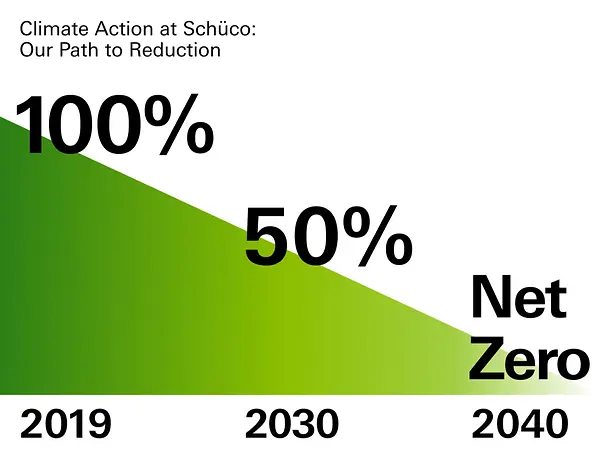
We have set ourselves the aim of lowering our greenhouse gas emissions (GHG emissions) to net zero by 2040. We have also been pursuing an intermediate aim of halving our harmful emissions by 2030 compared to the reference year of 2019.  

The greenhouse gas emission savings that Schüco wants to achieve by 2040 relate equally to the emissions that we produce ourselves through our own energy consumption (Scope 1), the energy we purchase (Scope 2) and the emissions of the upstream and downstream value chain (Scope 3). This includes the entire supply chain, as well as the fabrication, transportation and disposal of our products.

20250516_1448_Fußball-T-Shirt im Stadion_remix_01jvcj3tqvetssbtt978a4t0ma Kopie

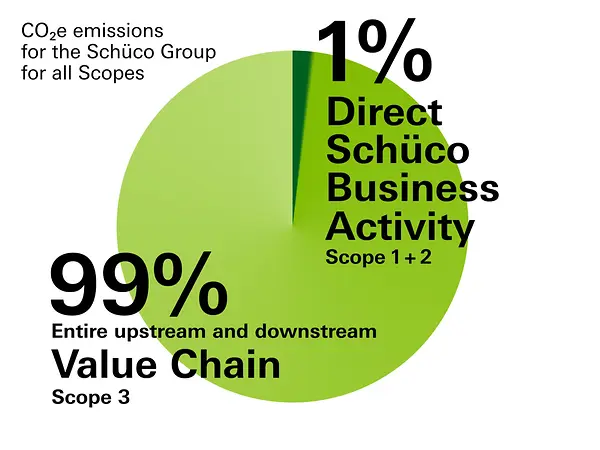
Up to 99% of the emissions fall under Scope 3, of which 88% is attributed to purchased goods and services. This means that Schüco only has a direct influence over a very small proportion of its emissions and the climate protection targets can only be achieved via close cooperation with the suppliers.  

20250516_1448_Fußball-T-Shirt im Stadion_remix_01jvcj3tqvetssbtt978a4t0ma Kopie

Our approach to reducing CO₂e in buildings

The building sector accounts for 34 percent of all CO₂e emissions worldwide. In order to avoid putting our livelihoods and business at risk, we urgently need more environmentally friendly construction methods. With its products and services, Schüco can make an important contribution in this regard:  

  1. With energy-efficient system solutions, we lower the energy requirement of a building during its usage phase and therefore also reduce the energy-related emissions (“operational carbon”).  

  2. We are continually working on reducing the embodied emissions in our products. These are generated during the production, transportation and disposal of the installed materials (“embodied carbon”).  

Our strategic levers for change

Sustainable product design

With our products, we contribute towards making building use more energy efficient, for example through systems that have particularly low thermal transmittance and high weathertightness. 

When designing our products, we place particular emphasis on durability, recyclability and the responsible handling of materials.  

Purchasing low-carbon materials

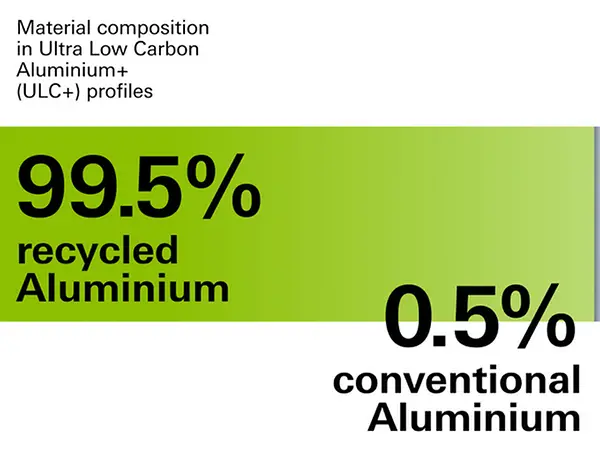
We are working on increasing the proportion of low-carbon aluminium profiles: Schüco distinguishes between “Low Carbon Aluminium” with a GWP value of 3.84 kg of CO₂e per kg of aluminium profile, “Ultra Low Carbon aluminium” with a GWP value of 1.99 kg of CO₂e per kg of aluminium profile, and “Ultra Low Carbon+ Aluminium” with a GWP value of 0.89 kg CO₂e/kg of aluminium profile. This low value is achieved above all by using post-consumer recycled material. In the PVC-U division – in which Schüco produces its own material – reductions in carbon can be achieved both by increasing the proportion of recycled materials used in production and by using bio-based raw materials. As a result, we have added the material classes “BALANCED PVC”, “RECYCLED PVC” and “BIO-ATTRIBUTED PVC” to our portfolio.  

In addition to purchasing low-carbon materials, we are also implementing a procurement strategy that takes account of sustainability criteria. In this connection, in 2021 we became the first systems business to be certified globally in accordance with the “Chain of Custody Standard” of the Aluminium Stewardship Initiative (ASI). This standard enables us to purchase ASI-certified aluminium and guarantee our customers that the material used in our aluminium profiles has been dismantled and processed in an environmentally friendly and socially responsible way throughout the entire value chain. 


Our PVC-U division also promotes the sustainable use of PVC throughout the value chain. As part of VinylPlus, a sustainability programme run by the European PVC industry, we meet the standards for the sustainable procurement of raw materials. 

Extended usage phase

Our materials aluminium, PVC-U and steel are all characterised by durability and recyclability. With proper care and maintenance, our PVC-U windows, for example, can be used for more than 50 years. Our aluminium systems are very mechanically robust and highly resistant to corrosion. The duration of use for aluminium windows given in the Environmental Product Declaration (EPD) is 50 years.  


We offer maintenance and repair services for products from all manufacturers. Through regular servicing and the targeted replacement of defective or ageing parts, high-quality products can stay in the usage cycle for longer.  

Return

Effective collection and return systems make it more appealing to give back building products that are no longer required. Through its membership of the A|U|F and Rewindo industry initiatives, for many years Schüco has therefore been actively working towards closing the material cycles for aluminium and PVC. 

By establishing RE:CORE and RE:CORE metals, Schüco has further increased its involvement in the recycling of end-of-life materials. We now offer our partner companies a recycling service for profile offcuts and old windows, thereby closing our own material cycle. 

Climate risk assessment

As part of a climate risk assessment, we analysed the resilience of our business model. In addition to physical and transient risks, opportunities that climate change poses for our company were also taken into account. Based on the recommendations of the Task Force on Climate-related Financial Disclosures (TCFD), three scenarios with different global warming pathways were considered:

“Transition” scenario
20250516_1448_Fußball-T-Shirt im Stadion_remix_01jvcj3tqvetssbtt978a4t0ma Kopie

“Transition” scenario

In a net zero scenario, an increase in the average global temperature of max. 1.5 degrees Celsius is presumed. To achieve this, governments across the globe are introducing comprehensive measures which have a considerable impact on companies. High-emission processes are not profitable and, as a result, are being substituted with lower emission technologies. In the building sector, the rate of energy-efficient building renovations will double by 2030 and the need for passive building cooling systems will also increase. With an overall increase in demand, recycled aluminium will account for more than half of the global aluminium requirement by 2050, while conventional aluminium will become much more expensive due to rapid rises in CO₂e-related costs. PVC will see a similar trend. New technologies are being used in primary production to reduce CO₂e emissions, which will increase investment costs for the manufacturer.  

“Disorderly transformation” scenario
20250516_1448_Fußball-T-Shirt im Stadion_remix_01jvcj3tqvetssbtt978a4t0ma Kopie

“Disorderly transformation” scenario

In this scenario, the climate targets are missed and the global CO₂e emissions will only be lowered by 12.6% compared to 2021. This will result in the average global temperature increasing to 2.5 degrees by 2100 compared to the pre-industrial era. For companies, this scenario has associated transient risks due to the political measures introduced for climate protection. In parallel, the temperature rise also increases the physical risks due to extreme weather events in exposed regions. This complex development affects newbuilds and building renovations. The property industry must therefore not only meet high energy efficiency standards but also increase the rate of existing building renovations. Buildings must also be better protected from heat, storms and flooding. 

“Climate change” scenario
20250516_1448_Fußball-T-Shirt im Stadion_remix_01jvcj3tqvetssbtt978a4t0ma Kopie

“Climate change” scenario

In this scenario, the temperature will rise by more than 4 degrees Celsius by 2100 compared to the pre-industrial era, resulting in serious changes to global ecosystems, ranging from rising sea levels and droughts to new precipitation patterns. Alongside this, there is an increased risk of localised extreme weather events, heatwaves and flooding. Buildings that are adapted to the climate and technologies for controlling the temperature are therefore becoming more important. At the same time, the greater demand for cooling is further increasing energy consumption. In addition to preventative measures to avoid buildings being damaged, storms and floods can also lead to a greater demand for renovations and newbuilds. Furthermore, companies in the construction industry are also confronted by price risks due to increasing energy demands. The crude oil price will double by 2050, which will also lead to higher PVC-U prices.

Implications for Schüco

Implications for Schüco

In summary, it can be concluded that the main risks for Schüco in the net zero scenario relate to the price and availability of low-carbon materials. At the same time, we will have to invest in climate-neutral technologies, e.g. for PVC-U production. The main opportunities can be seen in the sales markets: Schüco is already one of the leading providers of energy efficient products for buildings. In future, these will be just as in demand for renovation projects as for newbuilds. 

In the “climate change” scenario, Schüco is aware that acute or chronic extreme weather events may lead to disruptions in material supply chains. However, it is to be assumed that it will be possible to compensate for temporary disruptions with alternative sources of supply. Furthermore, the company's own sites in India are at risk of flooding in particular, which would result in high costs in the event of damage.  

However, advancing climate change also brings sales opportunities. It must be presumed that, in future, more buildings will be damaged by extreme weather events, which will mean more renovations and newbuilds will be required. Sun shading systems, well-insulated building units and generally climate-resilient window and façade constructions are also relevant for the market.  

20250516_1448_Fußball-T-Shirt im Stadion_remix_01jvcj3tqvetssbtt978a4t0ma Kopie

What we have achieved so far

In the reporting year, Schüco implemented various climate protection measures based on the identified decarbonisation levers (see data point E1-1).

Given that around 85 per cent of our total emissions are attributable to procurement, the focus was clearly on sourcing materials with a reduced COe-footprint. In our aluminium division, in addition to the standard aluminium available in the respective markets, we offered the aluminium grades ‘Low Carbon Aluminium’, ‘Ultra Low Carbon Aluminium’ and ‘Ultra Low Carbon Aluminium+’. 

  • Low Carbon (LC): has a high recycled content and/or is produced using green electricity; the Global Warming Potential (GWP) was 3.84 kg CO₂e/kg, corresponding to a reduction of approximately 46 percent compared to the standard profile
  • Ultra Low Carbon (ULC): contains at least 75 per cent post-consumer recycled material; the GWP value was 1.99 kg CO₂e/kg, corresponding to a reduction of approximately 72 per cent compared to a standard profile
  • Ultra Low Carbon+ (ULC+): contains 99.5 per cent post-consumer recycled material; the GWP value was 0.89 kg CO₂e/kg aluminium profile, representing a saving of 87 per cent compared to a standard profile

In the plastics division, where we manufacture our own products, a CO₂e reduction can be achieved both by increasing the proportion of recycled material in production and by using bio-based raw materials. Accordingly, we have expanded our portfolio to include the material categories “BALANCED PVC”, “RECYCLED PVC” and “BIO-ATTRIBUTED PVC” (click here to find out more about our materials). 

Since the launch of our sustainable procurement strategy, we have continuously expanded our procurement volumes. We are now passing on our experience in sourcing CO₂e-reduced materials to our international sites and, at the same time, beginning to roll out guidelines to their suppliers. 

Additional measures focused on gradually increasing the purchase of green electricity and on alternative mobility concepts, specifically the use of electric trucks and cars. We are currently evaluating the quantifiable reduction potential of these additional levers as part of a systematic analysis to enable us to steer our measures toward Net Zero even more effectively in the future. 

We regard measures for energy-efficient building use as a further lever. This is also reflected in our holistic product, service and consultancy approaches “Schüco Carbon Control” and “Schüco Value Up”.

20250516_1448_Fußball-T-Shirt im Stadion_remix_01jvcj3tqvetssbtt978a4t0ma Kopie

“By increasingly moving over to low-emission materials, including for international purchasing, and integrating these into market-specific product and service solutions in future, we will create the foundations required to consistently pursue our climate targets, even under difficult circumstances.”

Lars Knöner, Head of Sustainability Consulting

Best Practice

That's what we achieved in 2025 in the area of climate and energy.

20250516_1448_Fußball-T-Shirt im Stadion_remix_01jvcj3tqvetssbtt978a4t0ma Kopie

Focusing on materials

PVC from renewable raw materials

Innovative materials can contribute towards reducing the carbon footprint of a PVC profile. One such material is tall oil, which is a by-product of paper production. Compared to crude oil-based products, the carbon emissions in the PVC production process are up to 90% lower when renewable raw materials are used. Bio-attributed PVC is available for all Schüco PVC-U systems.

20250516_1448_Fußball-T-Shirt im Stadion_remix_01jvcj3tqvetssbtt978a4t0ma Kopie

Focusing on user comfort

CO₂e values at the touch of a button

In order to make it easier for building planners to simulate the carbon footprint, Schüco has developed the Environmental Calculator. With this software, it is possible to calculate how different PVC classes or aluminium grades affect the GWP value (see above) of the building. The calculation also incorporates factors such as profile size, surface finish, glazing and reinforcement options.

20250516_1448_Fußball-T-Shirt im Stadion_remix_01jvcj3tqvetssbtt978a4t0ma Kopie

Focusing on planning

Energy-efficient façade renovation in existing buildings

Under the name “OPVIAS”, Schüco is offering a new service for the energy-efficient refurbishment of non-residential buildings and apartments. On request, experts take care of both the planning and implementation of the renovation roadmap, the centerpiece of which is a building envelope inspection. Depending on requirements, various analysis methods are used, such as thermal and visual surveys, energy consultations and technical recommendations for windows, doors and façades. The service also includes advice on available grants. 

Climate and energy: Key figures

Key energy-related figures

Energy consumption and mix in MWh

Unless otherwise stated, the following key energy figures relate to the Schüco Group. They are the basis on which the company's carbon footprint has been calculated since 2011. The consumption rates have been taken from supplier and insurance company calculations. As part of an external audit of the corporate carbon footprint, a check is carried out every year to verify that the data collected is complete and accurate.  

For individual consumption data that was not available before the sustainability report was published, estimations were used and will be replaced with real figures at a later date.


Energy consumption (in MWh)20252024Change compared to previous year in %
Consumption of fuel from crude oil 26,02815,752 65.2
Consumption of fuel from natural gas 20,73020,930 1
Electricity, heat, steam, cooling from fossil sources  20,83516,06129,7
Consumption of self-generated non-renewable energy 157  
Total consumption of fossil fuels67,75052,74428,5
Proportion of fossil fuels in energy consumption in %60.3 54.99,8
Consumption from electricity, heat, steam, cooling (renewable sources)* 43,67743,2710,9
Consumption of self-generated renewable energy (excluding combustibles)  969195000
Total consumption of renewable energy44,64643,2713,2
Proportion of renewable energy sources in total consumption 39.745.1–11,9
Total energy consumption 112,39696,01517,1


*Electricity only, not district heating 

Climate-related emissions

GHG emissions worldwide

Schüco has been recording the climate-related emissions for its German sites since 2011. The GHG Protocol and the ISO 14064 standard form the basis for calculating the carbon footprint. Since 2023, data from administration and production (energy consumption, water and waste water), transport logistics (internal and external), business trips, journeys to and from work as well as paper consumption and printing is incorporated into the calculation, as well as the GHG emissions from purchased materials and their disposal. In order to define scientifically substantiated climate targets, since 2017 Schüco has also calculated the global emissions of the company. Data collection is based on primary data from the individual sites. If not available centrally, this data is requested from the international sites, then validated and recorded centrally. If this is not possible, the data is based on estimated and reference values. Our aim is to continually optimise the quality of the data. 


Data point 20242025Change compared to previous year in % 2030 aim 2040 aim Change compared to base year in % 

Direct GHG emissions in t CO₂e (Scope 1) 

11,86312,2002.89,7181,944–39.0
Indirect GHG emissions in t CO₂e (Scope 2), market-specific 2,9985,82694.31,26025219.0
Indirect GHG emissions in t CO₂e (Scope 3)1,702,2581,707,3150.3896,703179,341–5.1

a) Procurement 

1,330,0461,362,611 2.4   

b) Upstream transport 

 14,199 14,3561.1    

c) Business trips and journeys to and from work 

12,900 14,979 1.1    
d) Disposal 170,988141,400–17.3   
Total (market-specific)1,717,1201,725,3410.5907,681181,537–5.4

Status of target achievement

Data point  2025
(in t CO₂e)
2019
(in t CO₂e)
Change compared 
to base year (in %)
Target values 
2030 (in %)
Scope 112,20019,436–37.2–50.0
Scope 25,8262,519+131.3–50.0
Scope 31,707,3151,793,405–4.8–50.0
Total emissions 1,725,3411,815,3605.050.0

GHG intensity globally based on net income

GHG intensity per net income 2025 
Total GHG emissions (market-based) per unit of net revenue (in t CO₂e/million EUR)836