
Schüco Façade System AF VC
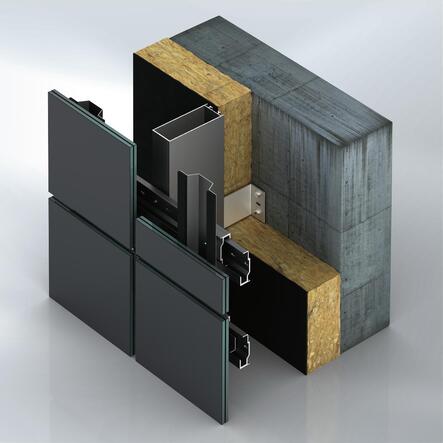
The Schüco AF VC ventilated façade makes building envelopes modern and efficient.
Rear-ventilated façades, or ventilated façades, are an important component for the design of future-proof building envelopes. They perform a range of protective functions, serve as key design elements and offer a variety of options to improve the energy efficiency and sustainability of buildings.
With the combination of the Schüco AF VC (Aluminium Façade Ventilated Construction) façade system and modules from the Schüco building-integrated photovoltaic (BIPV) system, Schüco offers stylish new solutions for the decarbonisation of buildings.
Increasing energy efficiency: ventilated façades enable an optimum level of building protection and significantly reduce the energy consumption of buildings by using BIPV.
Thanks to the Schüco BIPV modules integrated in Schüco AF VC, the façade is not only protected against the weather but also acts as an active energy source. The building produces its own power and thereby sustainably reduces the operating costs and CO2 emissions. This makes a valuable contribution to climate protection and to achieving global sustainability targets.
Aesthetics meets functionality: with the integration of the Schüco BIPV modules, the Schüco AF VC ventilated façade fulfils a protective function and opens up attractive design possibilities to architects, planners and clients for customised and visually impressive façade designs.
Schüco AF VC is available in four design options: Schüco AF VC point fixing Schüco AF VC full-frame fixing Schüco AF VC two-sided fixing Schüco AF VC concealed fixing Schüco BIPV modules can be used with all the design options.
Planning benefit
- Ventilated façades with BIPV modules allow the simultaneous use of solar energy for power generation and as a design element of the façade
- The use of insulated and non-insulated façades, seamless attachment to Schüco (ribbon) windows and to the non-ventilated façade or Schüco Perfect
- Suitability for different applications: renovations and newbuilds
- Different design versions and possibilities of use with BIPV, the models can be combined with each other
- Eligible for individual subsidies, for example, for material and labour costs as part of a building renovation
