Measurement of the airborne sound reduction of windows, doors, façades and other components on the test rig.

Testing of acoustics is carried out, amongst other things, in the Schüco International KG OneLab Technology Center in accordance with DIN EN ISO 10140-2, to verify the sound reduction properties of different construction units. Aside from windows and doors, façades, walls, sliding systems, roller shutter boxes and ventilation units can also be tested for acoustics. Would you like to test a system or product that is not listed here? No problem – just contact us. We will be happy to check whether it is possible to also acoustically test your component and how.
Prüfmuster_TransmissionVariabel

The tests are carried out in specially equipped measuring rooms with variable test openings – both for testing longitudinal sound measurements from room to room (horizontal and vertical) and for testing the sound transmission of a component (measurement of transmission) against external noise. This allows the acoustic performance of a component to be evaluated in realistic settings, as precisely as possible.

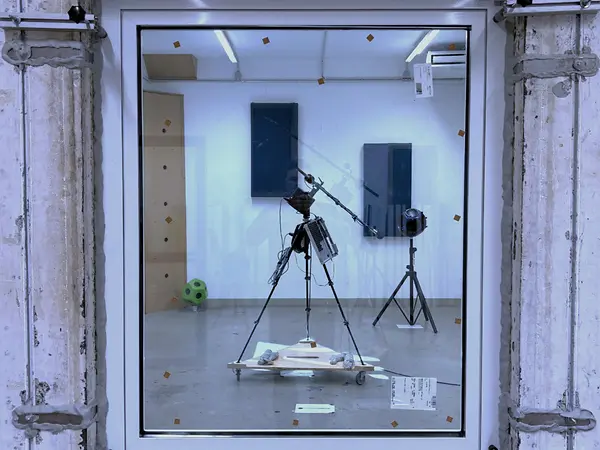
Here, you can see a built-in test specimen that is mounted on the reception room side. Since test specimens can vary in size, the empty space of the test opening is sealed with highly sound-absorbing materials. Test specimens of up to 3000 mm x 3300 mm (WxH) can be installed in this test opening.

MehrteiligesPrüfmusterProfile_TransmissionVariabel

The walls of the test rig are double-skin, so that the influence of disruptive noise from outside is kept to a minimum.

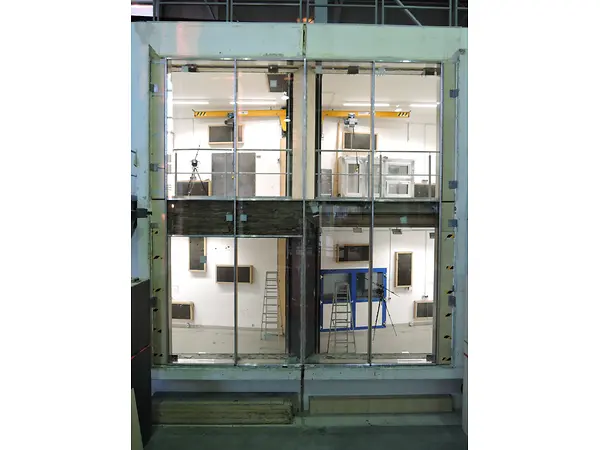
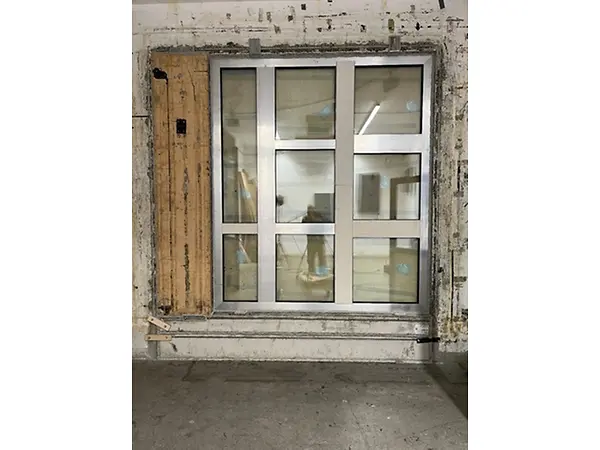
Here, you can see that a multi-part test unit is made up of fixed fields. In order to determine the influence of wide profiles, some of them have been covered with plasterboard and bonded across the entire surface.

Why is airborne sound reduction of building components and therefore sound reduction in general so important?

If you want to construct a building in a noisy environment, the airborne sound reduction of the components must be taken into account. In the planning phase, the surrounding area must be carefully examined in terms of acoustics. The noise from busy roads or even railway tracks is used to calculate and determine an increased level of airborne sound reduction. These sound reduction requirements must then be fulfilled. Disruptive noise can be greatly reduced by using appropriate windows and walls, as well as good building technology in the interior, which significantly increases comfort. Whether a living space or an office, an environment that is free from disruptive noise is essential for relaxation or focused work.

Prüfmuster_TransmissionStandardgröße

Shown here is a standard size test specimen. The standard size is 1230 mm x 1480 mm (WxH). The units are installed with a 10 mm continuous gap. This gap is filled with foam and sealed on both sides with window putty.

How is a measurement for an airborne sound reduction test carried out?

For each building acoustics test, there is a transmitter room and a reception room, which are separated from each other by a double-skin wall. There is a loudspeaker in the transmitter room, which produces a constant sound field. Movable microphones are positioned in the transmitting and receiving rooms. The microphones are movable so they can measure the sound level in different positions and to compensate for spatial fluctuations. The rooms are structurally and acoustically separate from one another, so that sound can be transmitted primarily through the built-in component. The test specimen can be inserted in the opening between the two rooms (for measuring airborne sound reduction in the transmission test opening) or built in front of the test rig in the test opening (for measuring the flanking sound or longitudinal sound). A difference can be calculated from the sound pressure levels in the two rooms and the sound reduction index can be determined from this.

How is the airborne sound reduction index determined in windows and façades?

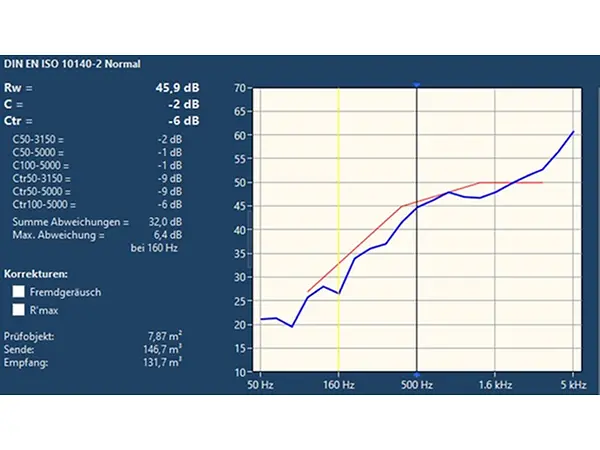
A measurement is recorded in a frequency spectrum from 50 Hz to 5 kHz and is shown in decibels (dB). Only frequencies between 100 Hz and 3150 Hz are considered for the evaluation. The sound reduction index is calculated in accordance with DIN EN ISO 717-1. It describes how a defined reference curve shifts until the sum of the negative values is equal to 32 dB. The airborne sound reduction index Rw can then be read from the measured curve. The higher the dB value, the better the sound reduction of the component that is being tested. This is a test rig value that takes into account a predicted uncertainty of upto 2 dB (up to 5 dB for doors). The sound reduction index is, first of all, independent of size. However, DIN 4109 specifies values for correcting the size. The sound reduction index should not be confused with the building sound reduction index R‘w. The building sound reduction index includes alternate sound transmission routes, such as the building joint section detail, which is not tested on the test rig.

Auszug_AuswertesoftwareNor850

An extract from the evaluation software for measuring and calculating airborne sound reduction Rw. The red curve represents the reference curve that is displaced from the standard. The blue curve is the measured difference in sound level.

Prüfmuster_Flankendämmung

A façade unit is installed here in the flanking sound test rig. Here, the horizontal and vertical flanking level difference Dn,f,w can be measured.

SchematischeDarstellungFlankeHorizontal

Not only are tests conducted in the development phase, but test specimens for special solutions are also set up by fabricators and measured according to the acoustic regulations in the specification. This may be necessary if special profiles are used, for example. This enables optimisation to take place during testing, which helps requirements to be met.

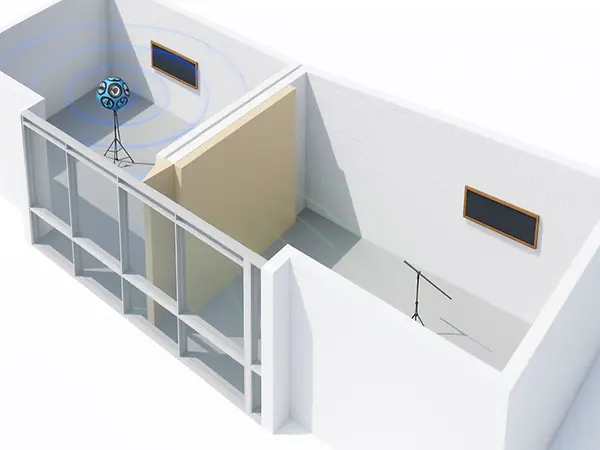
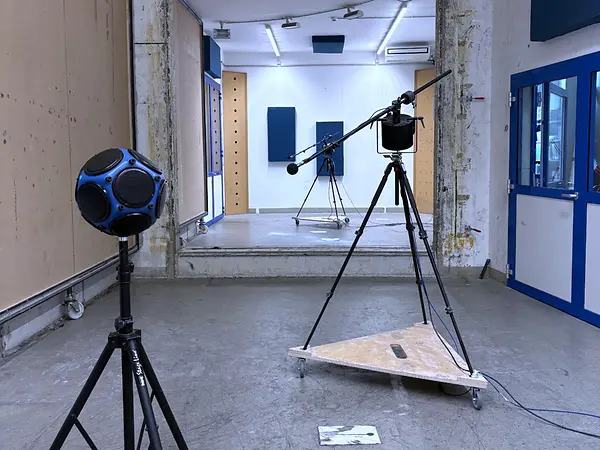
This is a schematic diagram of horizontal longitudinal sound reduction. The dodecahedron speaker (a type of loudspeaker) generates a sound field (marked in blue), which is transmitted to the reception room via the test specimen (marked in green). The mircophone is mounted on a rotating boom stand to measure the sound pressure in different positions.

Is there anything I should pay particular attention to when planning windows or façades?

There are a few elements that have a negative effect on sound reduction. These include, for example, wide profiles. Measurements have shown that wide profiles have a negative impact on the airborne sound reduction. Sound takes the path of least resistance. For this reason, components with a lower sound reduction value have a significant impact on the overall result. Likewise, large units also have a significant impact. In accordance with DIN EN 14351-1, Appendix B, Tab B.3, corrections are necessary depending on the size of the window from a value of over 2.7 m². The influencing factors mentioned above must be taken into account, especially if the requirements for the window or façade are high. In addition to these corrections, there are other factors in Table 1 of DIN 4109-35 that must be taken into account. Among other things, there are correction values for units with a frame proportion of > 30%, double-vent units, fixed glazing with increased pane proportion, windows < 1.5 m² and units with glazing bars.

Bauobjekt_Anbauteile

Attachments made from light metal, as shown in the image, can also influence sound reduction by several decibels (dB). The same applies to safety barriers, such as a French balcony. Exact values cannot be provided in this context. If concrete figures are required, testing is essential.

What else does the building acoustics team in the Schüco OneLab Technology Center do?

In addition to conducting tests on the acoustic test rig, they also complete advisory work and other tasks. Not all newbuilds are required to undergo testing, as many things can also be answered using calculations and empirical values. More than 25 years of building acoustics and around 40,000 sound measurement tests have helped to compile an extensive pool of data, which can be used to answer everyday questions. These new insights, which are constantly being supplemented with new information, are passed on to Schüco colleagues via training courses. We also offer training courses that focus on acoustics for our customers. Please don't hesitate to get in touch.

Do you have a customer account as a fabricator and would like to take part in a training course on acoustics? Then what are you waiting for? Get yourself registered today!

If you are not already part of the Schüco community, please get in touch with your local Schüco contact person.

Can the sound reduction, i.e. the sound reduction index of windows or façades also be calculated?

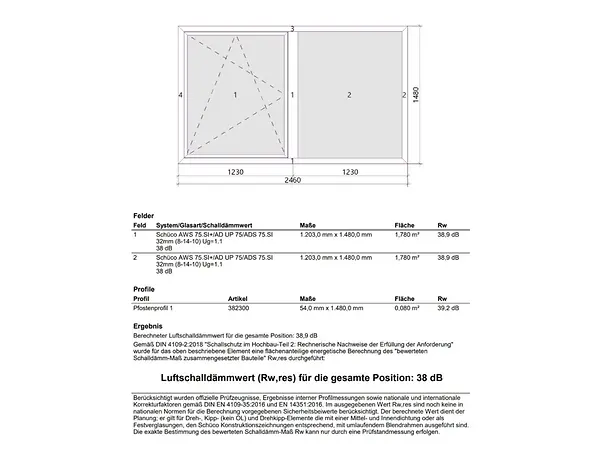
Yes, the sound reduction index of windows or façades can be determined mathematically. However, this requires input data from over 25 years of testing experience in building acoustics in the OneLab Technology Center. This data has been collated in a calculation tool. This is accessible to our customers. This allows a wide variety of Schüco window and façade constructions to be drawn and the sound reduction index to be determined and shared.

Ausschnitt_SchüCal_Quaro

Extract from the SchüCal calculation software with a sample unit that has already been calculated. The glazing has a sound reduction value of Rw, glass = 38 dB.

Do you have any questions about acoustics or are you planning a test?

Regardless of whether you have a specific test request or initially just want to know more, we are here to help.

If you are already planning a test, we will need the following information:

  • A drawing or description of the test specimen
  • The type of test you would like to conduct (e.g. transmission, longitudinal sound test)
  • Are there specific requirements for the test specimen? If yes, what are they?

Additionally, we offer acoustic measurements using a state-of-the-art acoustic camera. This allows sources of sound to be visually detected with exceptional accuracy, including directly at your site. This means that acoustic weak points can be systematically identified and analysed.

Are you still unsure? Would you like an initial assessment? No problem – we will be happy to provide you with personalised advice to help you find the right solution for your project.

Contact us – we look forward to hearing from you. Together we can lead your project to success.