IKEA City Centre

IKEA store in Vienna – multifunctional grid structure

At Vienna's Westbahnhof station, IKEA has constructed a next generation furniture store. Urban and sustainable, it has 160 trees and a publicly accessible roof terrace. querkraft Architekten chose Schüco window and façade systems for the building envelope with its varied, grid-like structure. Inside the building, safety is ensured by fire protection systems made from steel and aluminium. 

项目案例详情

建筑类型 零售与批发
产品 幕墙
旭格系统 FWS 50 AWS 75.SI+
特征 新建建筑 BREEAM 防火
地点 Vienna, Austria
竣工时间 2021
建筑师 querkraft architekten zt gmbh
专业公司 HT Generalunternehmer & Industriebau GmbH
图片版权 © pierer.net

The Swedish furniture manufacturer IKEA wanted to present itself as a “good neighbour” with its store at Vienna's Westbahnhof station. For the design of the almost 30,000 m² newbuild, this meant doing away with the client's usual hermetically sealed “blue boxes” and instead constructing an open, urban building that looks to the future. The aim was to have a presence in the new office and commercial district that has emerged near Vienna's old Kopfbahnhof main station in recent years – a presence which was to prioritise architectural quality above all and rely less on striking colours and oversized logos. In 2017, the company launched a multi-stage architectural competition, which was ultimately won by Viennese architectural practice querkraft Architekten. Four years later the newbuild became officially operational. 

“It was an unusual collaboration with a courageous client. The city of Vienna had some challenging specifications. The building had to be 100% car-free – there couldn't even be a single employee parking space – and the roof had to have a public terrace. IKEA didn't just achieve all of that, they were also very open to suggestions where other things were concerned. Their restraint with regard to the corporate design is also worthy of note. There is much less blue and yellow on the building and the IKEA logos are much smaller than we suggested in the competition.”

Jakob Dunkl, Owner of querkraft Architekten

Geöffnete Schiebetür von Schüco mit Blick in den Wohnbereich

Three-dimensional urban park with 160 trees

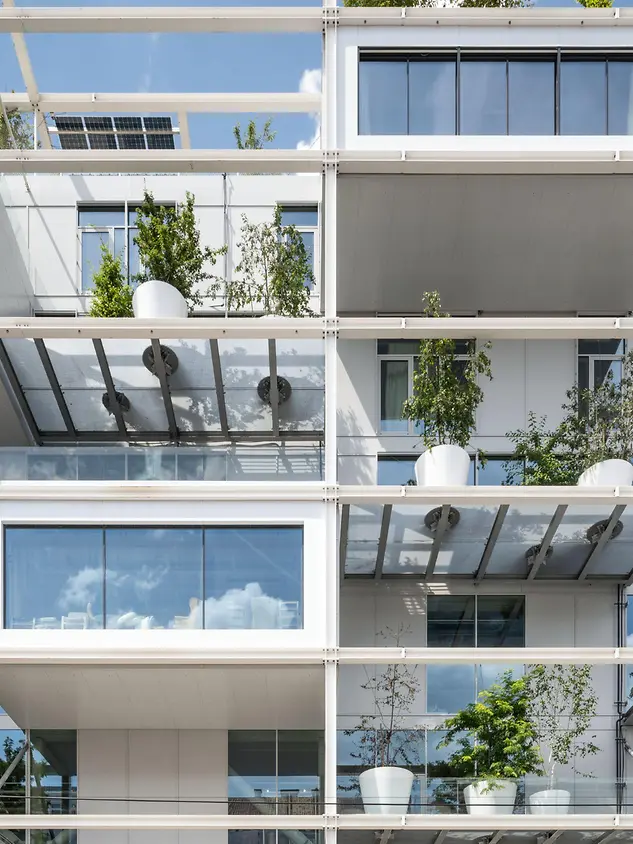
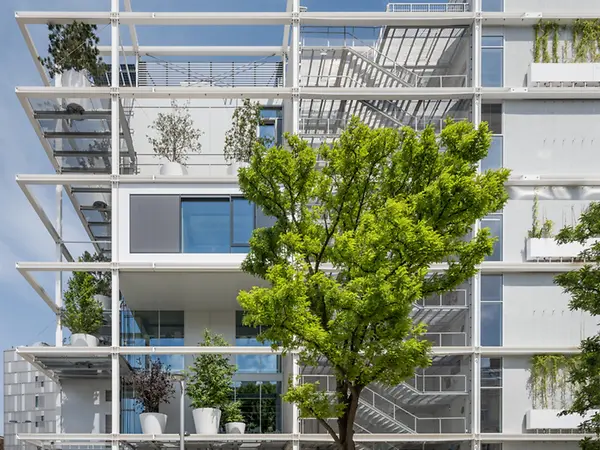
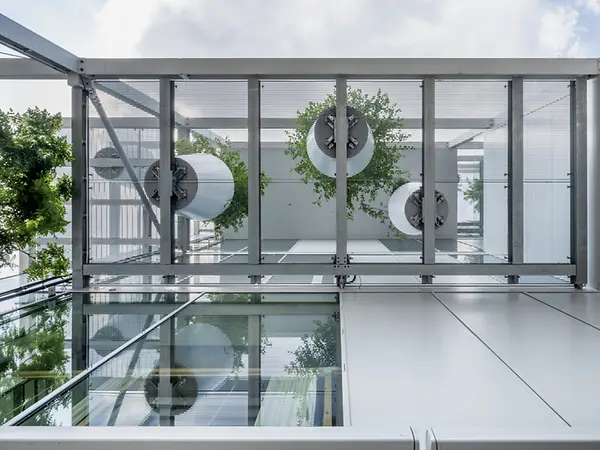
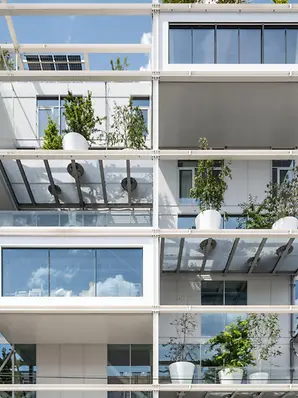
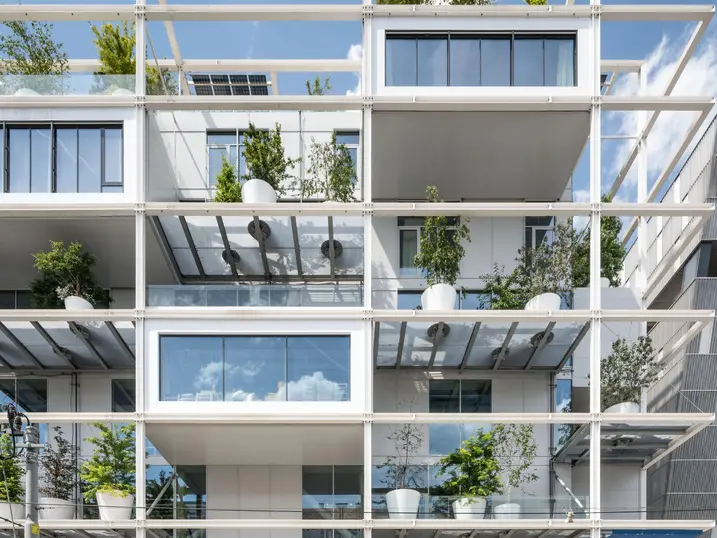
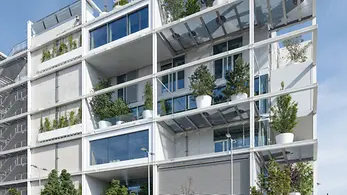
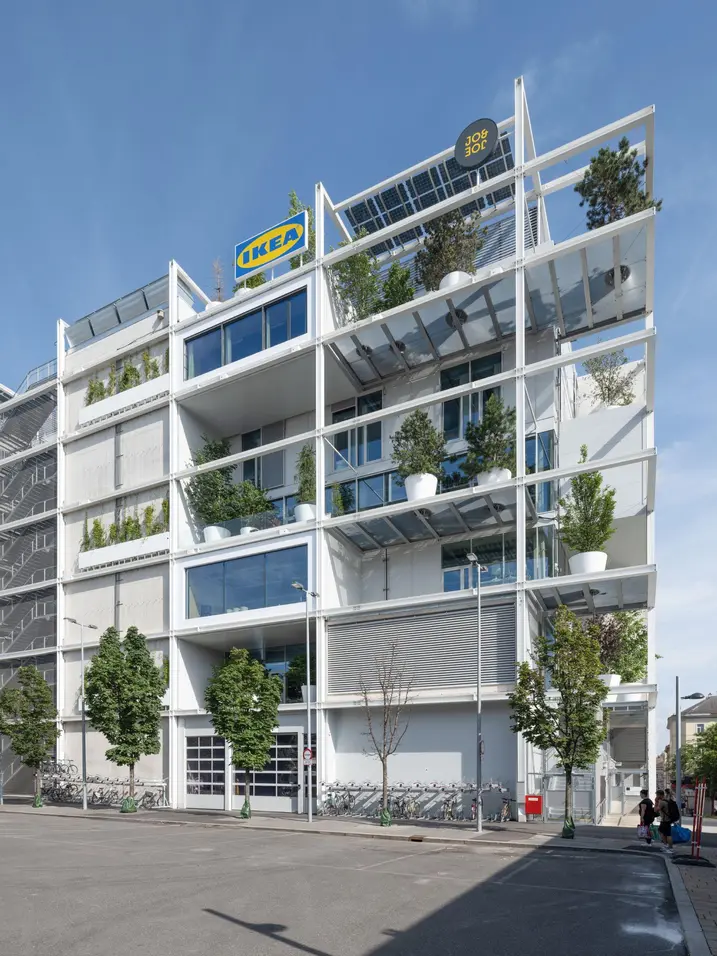
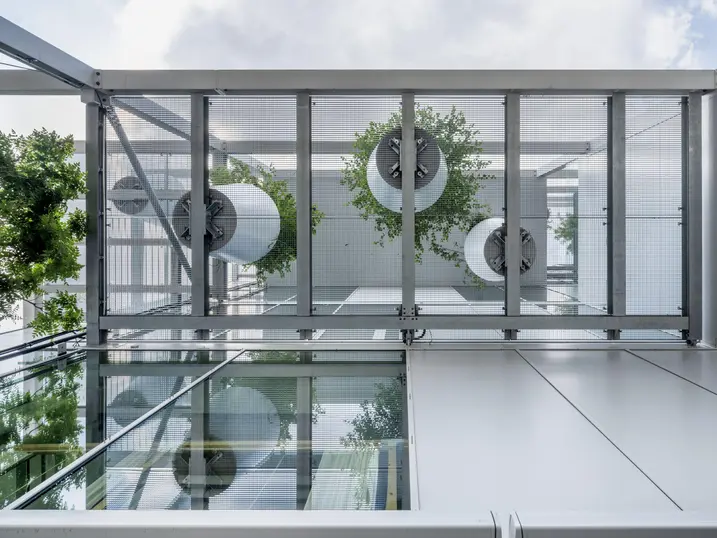
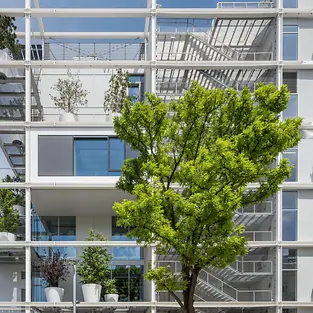
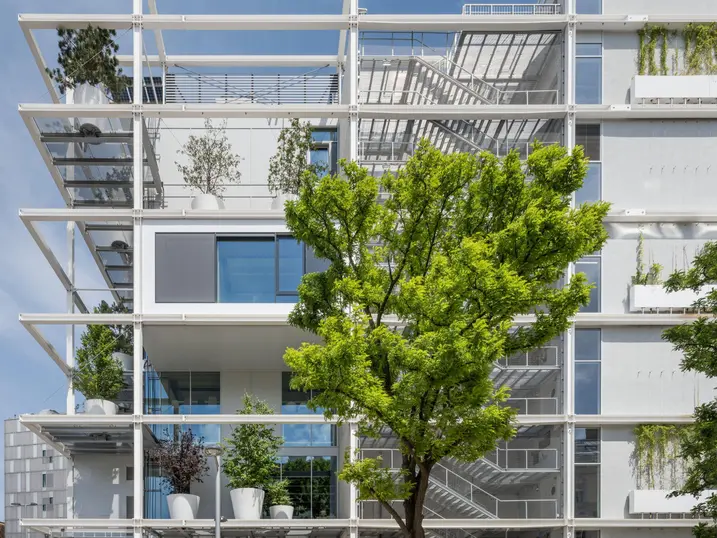
The architects' design created an image reminiscent of the IKEA range of products – a seven-storey steel shelf-like structure alternating between closed cubes glazed at the front and open compartments made from grilles housing large potted plants. Sonja Mitsch, project manager at querkraft Architekten, explains the concept: “A late 19th century building belonging to the Austrian Federal Railways, which was mostly empty, was demolished to make space for the new building. If you asked the residents ‘What would you like there to be in its place?’ most of them would probably answer ‘a park!’ And with the new inner-city IKEA store we have given them a three-dimensional park in which there are more trees than there would have been on a ground-level green space of the same size.” 

First building to achieve GREENPASS Platinum

In total, 160 trees grow on and around the building in plant pots that are up to 1.90 m high and made from white painted steel. Each one has an automatic, sensor-controlled irrigation system that can respond to its individual water requirements. 

When selecting the plants, the landscape architects from Kräftner Landschaftsarchitektur and Green4Cities GmbH chose species that would be best suited to the Viennese climate or which are commonly found in southern Sweden, the home of IKEA. With its greenery concept, the first inner-city IKEA is one of the first buildings to ever achieve Platinum level in the GREENPASS certification system. This system sees landscaped buildings and districts assessed against six urban challenges and three bonus challenges, including water, climate, air, biodiversity, energy and cost.

BREEM certified with an “Excellent” rating

The newbuild also achieved top marks in the BREEAM building certification system with the rating “Excellent”. The impact of the greenery concept on the urban climate can also be measured quantitatively. According to computer simulations by the planning team, the trees reduce the air temperature around the building on a typical hot day by up to 1.5 °C at pedestrian level. In terms of the perceived temperature, whereby thermal radiation from the surfaces also plays a role, the effect is even greater.

Geöffnete Schiebetür von Schüco mit Blick in den Wohnbereich

A range of applications in a single building

The sustainability concept also involves IKEA sharing its furniture store with other users. A Jo&Joe hostel with 345 beds has moved into the 5th and 6th floors and the ground floor houses a small area on the south side for independent retailers, most of which were already resident on site in the late 19th century building that was torn down. Here, the newbuild continues the row of shops along Mariahilfer Straße, forming a striking end point in the direction of Westbahnhof station and the Wiener Gürtel city road.

Geöffnete Schiebetür von Schüco mit Blick in den Wohnbereich

Attractive visitor roof terrace

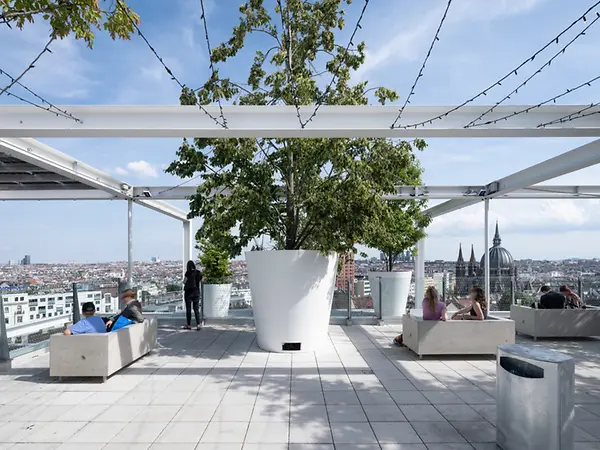
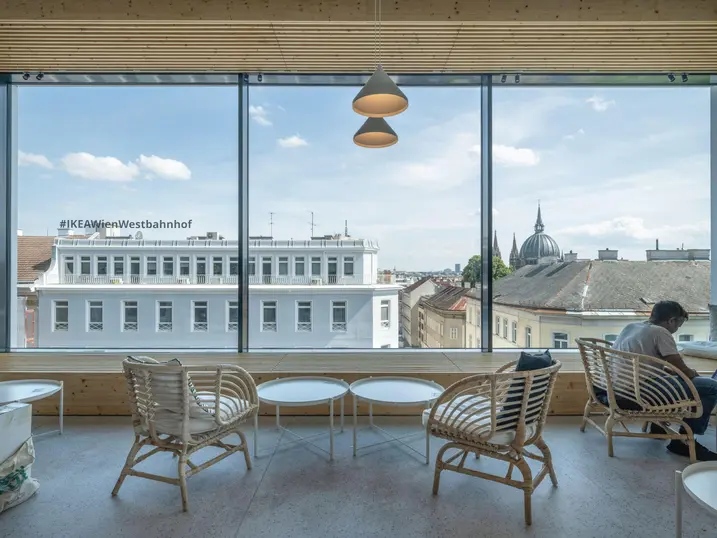
However, the roof is where the architects created the biggest public attraction. Here, the striking white steel skeleton continues upwards like an open pergola, punctuated with sun shading louvre blades and solar panels. Underneath it is a public terrace spanning the entire roof area. From here, visitors can see the whole of Vienna's city centre and the hills around the Austrian capital. Apart from through the atrium, visitors are also able to access the roof terrace via an external staircase and multiple lifts. These, the emergency exit staircases and the riser shafts for the building technology are integrated into the external steel skeleton. This meant up to 50 x 60 m of adjacent floor space was freed up inside the building as there were no stairwells or reinforcing building cores. “It's a similar principle to the Centre Pompidou in Paris – which is a building that we admire a great deal,” comments Jakob Dunkl. “The main difference is that we integrated the technology in a less elaborate way.”

Mullion/transom façade for reliability and flexibility

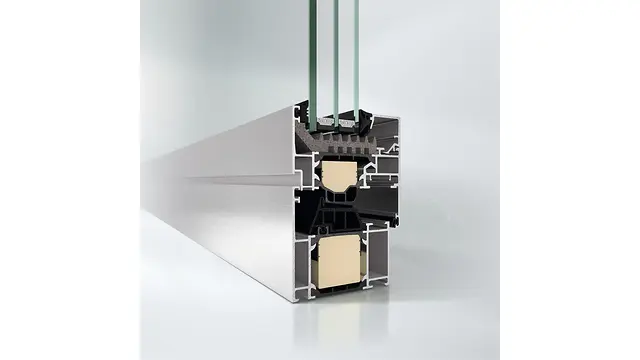
For the actual building envelope behind the steel “shelves”, the FWS 50.SI Cradle to Cradle Silver certified mullion/transom system was selected. Here, glass areas alternate with closed façade panels, which are clad with white steel sheets on the outside and plasterboard panels on the inside. “The mullion/transom façade was a suggestion from the main contractor,” remembers Jakob Dunkl. “Compared to the special construction that we originally had in mind, it offers many advantages in terms of weathertightness and guarantees, for example. The system is also flexible enough that the client can decide relatively late on where they want to position the closed panels and the glass areas.”

Everything from a single source

Sonja Mitsch adds: “All the façades for the building were executed using Schüco systems. We chose Schüco because they give us the certainty that we will actually be able to implement the sizes we want.” In Alukönigstahl from Vienna, the architects had an expert partner by their side who was able to advise them on façade technology and fire protection, while with Jansen steel systems and Schüco aluminium systems, they were able to obtain a high-quality range of products from a single source.

Geöffnete Schiebetür von Schüco mit Blick in den Wohnbereich

Display windows for the furniture store

The glass units in the oriels are particularly large and project out of the building into the steel grid – they are referred to as “add-ons” by the architects. The glazed fronts also serve as the IKEA shop windows. Each one is 8 m wide and 3 m high, and made up of just three glass fields. The profiles of the Schüco FWS 50 system are just 50 mm wide and form a barely visible break between the fields.

Geöffnete Schiebetür von Schüco mit Blick in den Wohnbereich

Ventilation vent for the hostel

Where the hostel is located on the upper floors, the glass areas are divided into smaller sections. There are even differences between the mullion/transom façade that is located further inwards. In the IKEA storeys, access to the balconies is provided exclusively by individual Schüco AWS 75.SI+ window doors, integrated as insert units into the mullion/transom façade. In the hostel, however, there are a lot of manually opening windows from the same Schüco system, which are fitted with an anti-turn lock so that they can only be tilted. This is mainly for safety reasons, as not all of the balconies can be accessed – most of them don't have any balustrades and are only used as a place to put the pot plants.

Geöffnete Schiebetür von Schüco mit Blick in den Wohnbereich

Large span widths for open spaces

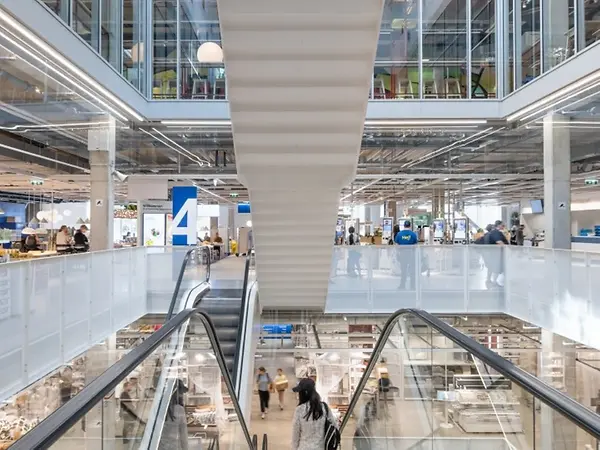
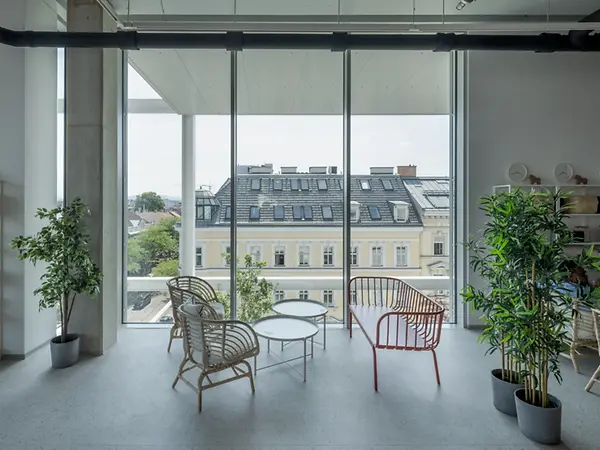
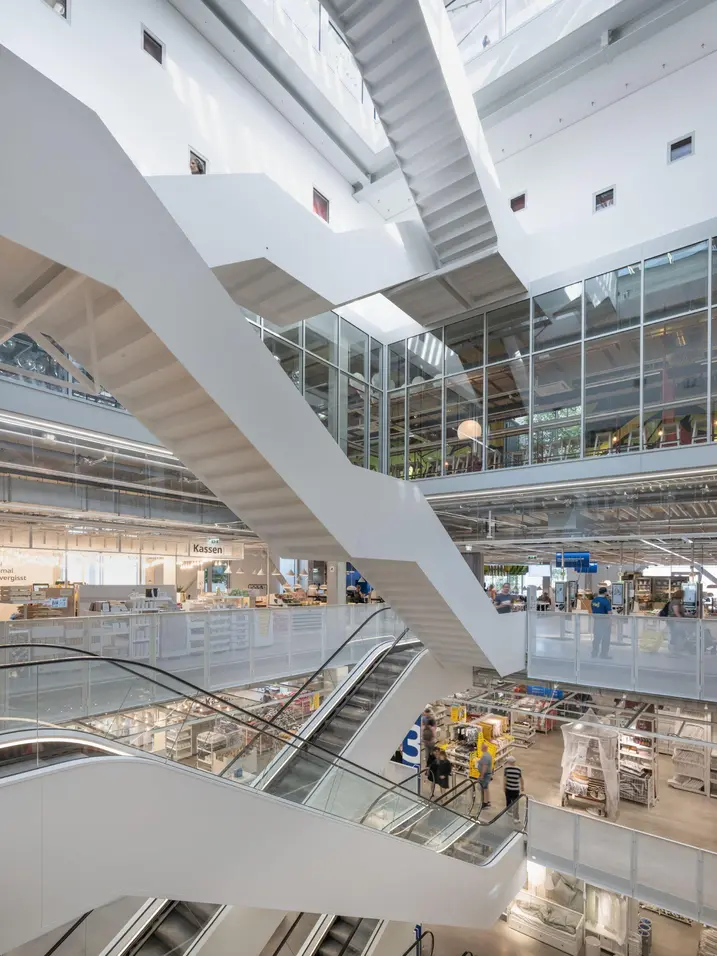
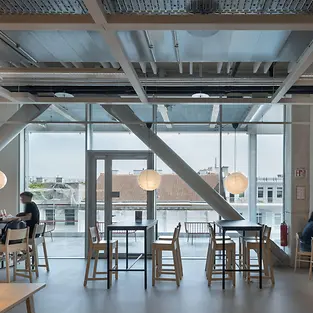
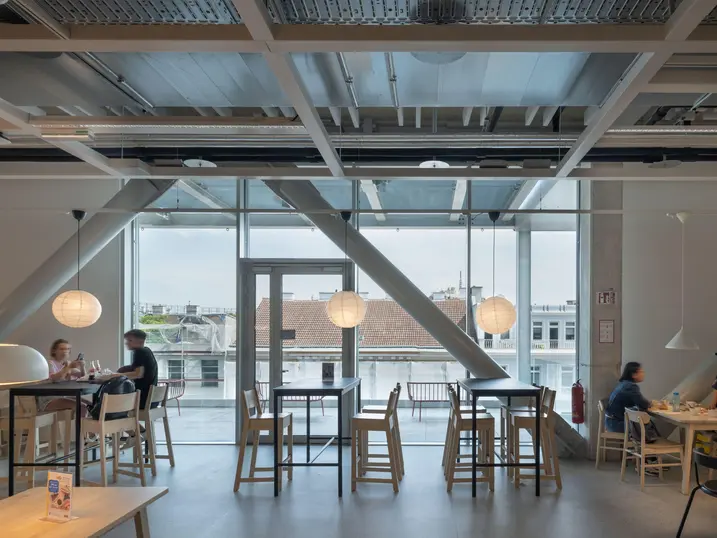
The open feel that the building conveys to the outside world is also continued on the inside. Here, IKEA occupies the four lower storeys with its showroom, self-service goods area and the obligatory restaurant. Escalators circulate around a central atrium up to the 4th floor. Beyond this, the hostel and roof terraces can be accessed via traditional staircases or the lifts. Inside the building, the 4.50 m deep steel grid gives way to a reinforced steel skeleton with span widths of approximately 10 m. The large distances between supports allow the spaces to be used flexibly and furnished differently time and again. The interior is dominated by exposed concrete ceilings with visible pipework, concrete floors with a power-trowelled finish, screed without any additional coverings, white painted steel and lots of glass. 

The fire protection concept also contributes towards the spaciousness of the interior. The entrance area and the atrium, as well as the 2nd and 3rd floors, combine to form a joint fire compartment. In the event of a fire, the 1st floor can be separated from the large, vertical air space by means of fire curtains. 

Safety and transparency combined

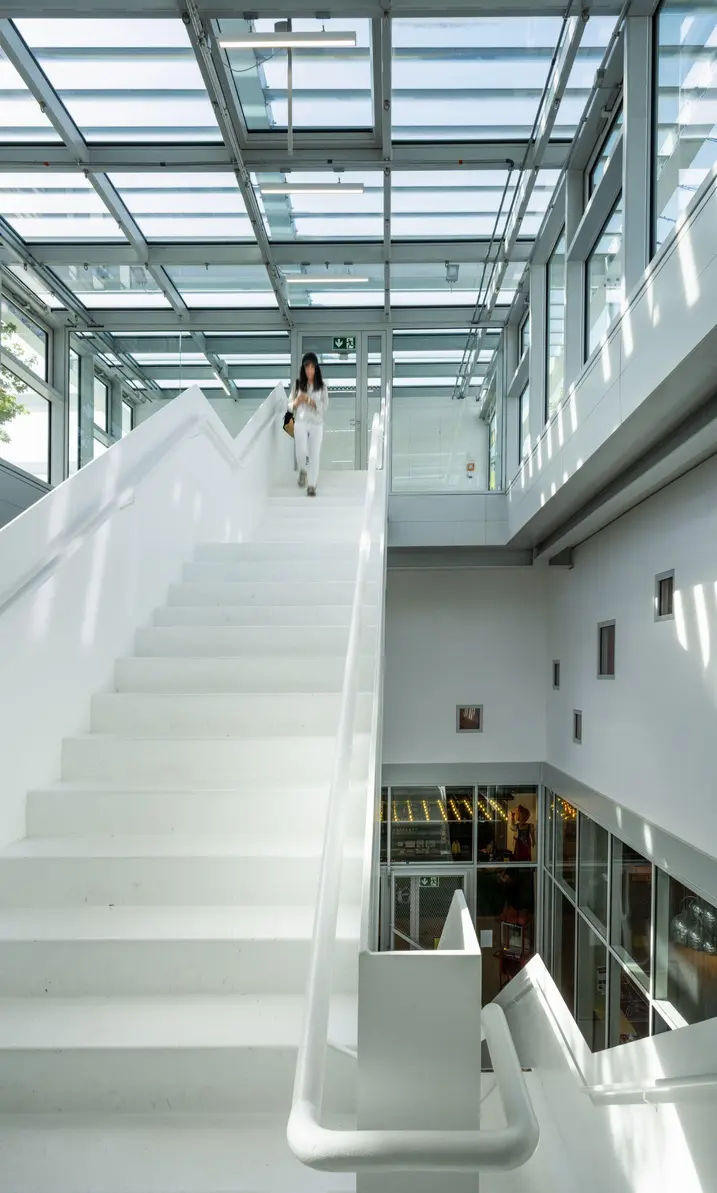
In the hostel, the architects combined effective fire protection with maximum transparency. A storey-height, steel Jansen VISS Fire TVS EI60 mullion/transom façade provides 60 minutes of fire resistance all around the atrium. Steel Janisol 2 EI30 and Janisol C4 EI60 fire doors are integrated here. One storey higher, closed white walls predominantly surround the atrium. Only a few individual Schüco ADS 80 FR 60 fixed fire-resistant glazing units provide views from the hostel into the large air space. 

While the approximately 50 m deep building floor plans were advantageous for the furniture store, they proved challenging for the operation of the hostel. In order to provide the interior spaces with enough light, the architects added two new two-storey inner courtyards and a further three-storey inner courtyard on the 5th and 6th floors in addition to the large atrium which spans all of the floors. The courtyards are also surrounded by Schüco FWS 50.SI mullion/transom façades – although here these have a fire protection function in some areas to prevent the spread of fire through the inner courtyards. 

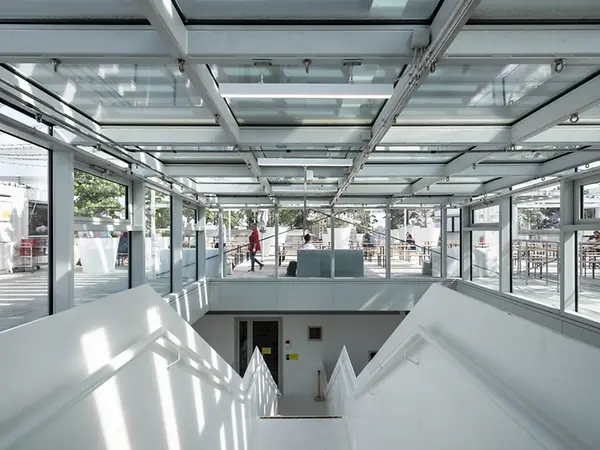
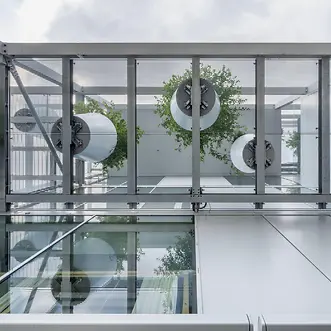
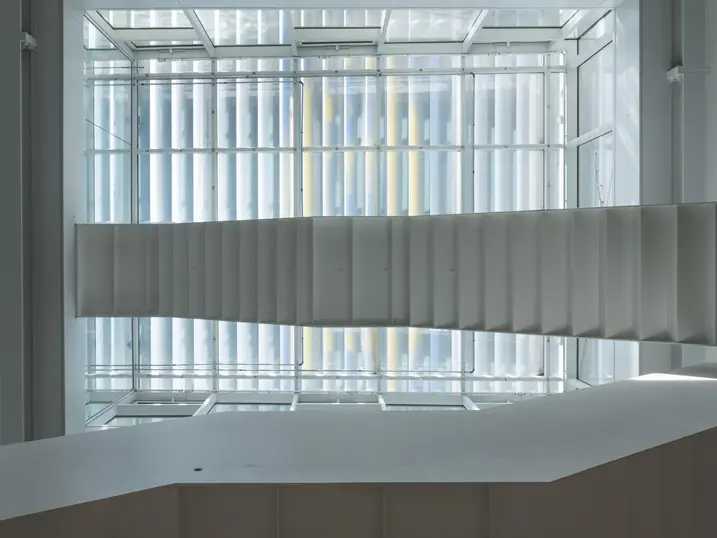
The glass roof above the atrium did not require any fire resistance. It is, however, extremely important for removing smoke from the building. For this, the architects chose the Schüco AOC 50 ST add-on system on a substructure made from rectangular steel tubes. Two opening vents are integrated in the system for smoke and heat exhaust ventilation, which open automatically in the event of a fire. 

产品信息

FWS 50

旭格FWS 50幕墙系统

性能卓越的构件式幕墙,可视面宽度50 mm — 为实现不同系统解决方案打下基础

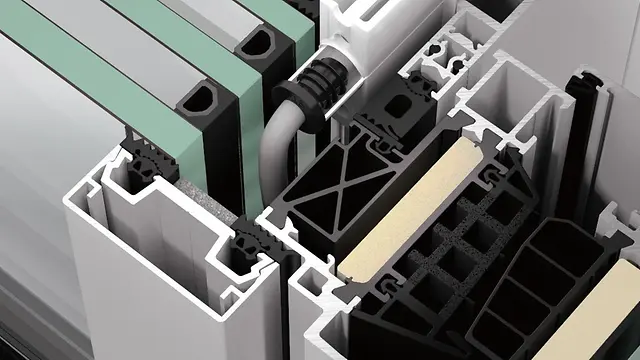
作为幕墙和采光顶的基础系统,旭格FWS 50幕墙系统提供极大的灵活度和引人注目的设计选项 – 且优化了加工和安装进程。广泛的系统类型打造多种解决方案,满足多样化的要求,实现各种应用。

整合进型材的通透护栏系统天衣无缝地融入幕墙外立面。无需打断型材即可满足落地窗式开启单元的防护要求和极低的护栏高度,型材可视面宽度保持不变。

这个可视面宽度为50 mm的构件式幕墙系统实现极高程度的设计自由,提供多种压板和幕墙罩盖选项,并能和旭格门、窗、推拉系统组合使用。

经过优化的系统组件保证轻松安全地整合电动组件,如用于自动化旭格门系统或遮阳装置。

旭格通过这个构件式幕墙系统开发生态产品,践行可持续发展。超隔热的旭格FWS 50.SI幕墙系统凭借其可回收特性和极少的毒素含量受到独立的C2CPII研究所与汉堡环境保护促进协会认可,荣获“摇篮到摇篮”(C2C)银奖证书。

了解更多​

AWS 75.SI+

旭格AWS 75.SI+窗系统

优化隔热性能、安防水准和加工流程

结构深度为75 mm的旭格AWS 75.SI+超隔热窗系统作为旭格AWS窗系统平台的一部分提供多样化的节能建筑外立面解决方案,满足不同应用需求。这个超隔热窗系统可按建筑设计要求作为洞口窗、带状窗、幕墙塞窗或与旭格门系统组合使用。

对开发商和建筑师还有另一项优势,该窗系统能实现多种开启类型,如内倾推拉、上亮下悬及垂直摆扇。

作为系统平台的组成部分,该窗系统提供众多的型材产品,例如组角竖框、结构竖框、对称和不对称竖框,此外还有各种设计类型以及更多与其他旭格产品的组合方案,例如与旭格遮阳系统或旭格通风系统组合。

这个引领未来的扩展系统基于“从摇篮到摇篮”(C2C)概念 — 适用于设计规划可持续发展建筑,使用经过有害物质和回收率检测评估的建筑组件:原材料制成的产品在使用寿命到期后经过回收能重新作为高品质材料循环使用。旭格AWS 75.SI⁺窗系统通过了汉堡环境保护促进协会(EPEA)的检测,符合美国C2C产品创新研究所颁布的现行C2C标准并获得了银奖证书。

了解更多​