OWP 12

New office building with BIPV on the Drees & Sommer campus

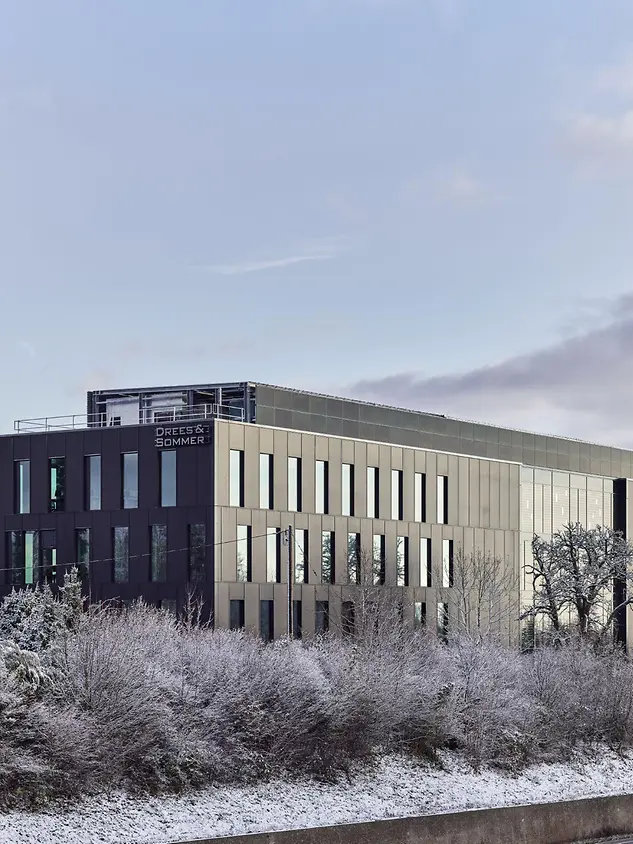
With their own new office building Obere Waldplätze 12 in Stuttgart, known as OWP 12, Drees & Sommer has brought their business philosophy of "sustainable, digital, innovative, economic" to life and used lots of promising, futuristic technology from the construction industry to achieve this. OWP 12 was created using the newest planning and building methods in accordance with the Cradle to Cradle principle and it shows what energy-plus architecture can do today thanks to the slimline, high-performance façade with building integrated photovoltaics (BIPV) from Schüco.
项目案例详情

建筑类型 办公与行政
产品 幕墙 BIPV(光伏一体化)
旭格系统 BIPV
特征 新建建筑 脱碳 BREEAM认证
地点 Stuttgart, Baden-Württemberg
竣工时间 2021
建筑师 SCD Architekten Ingenieure GmbH
专业公司 FKN Fassaden
图片版权 © Juergen Pollak

OWP 12 – a green powerhouse

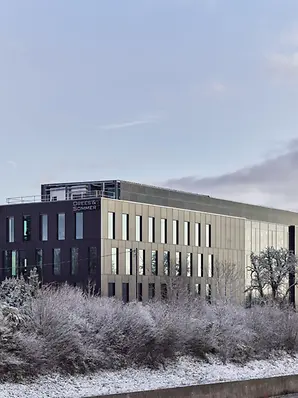
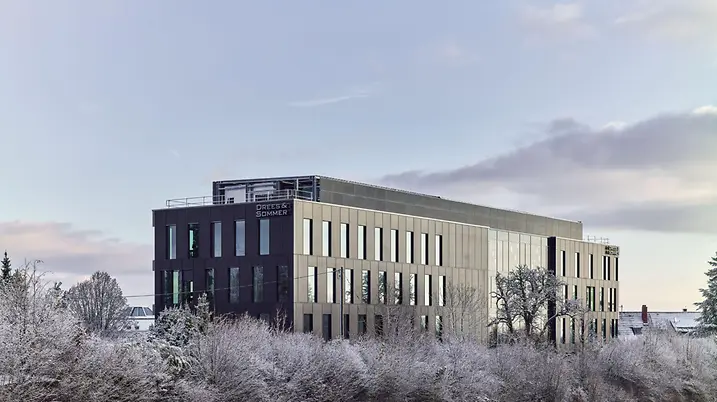
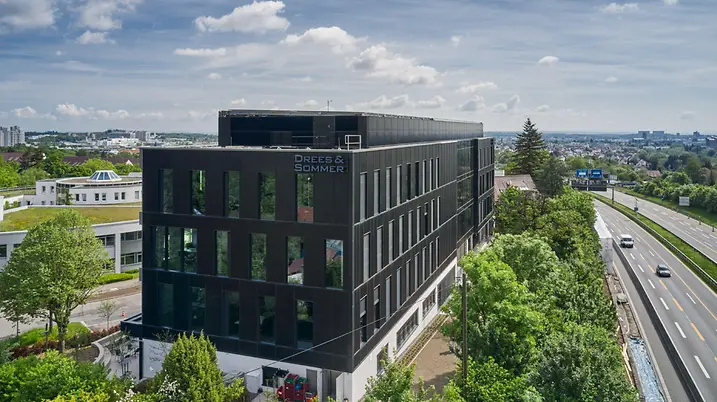
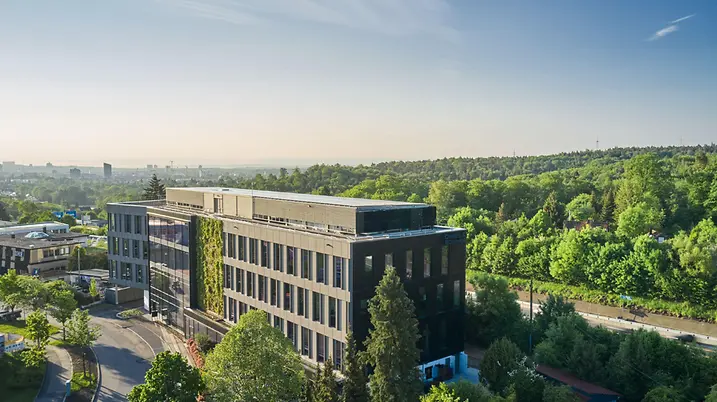
OWP 12 towers like a monolith over the A 831 just outside Stuttgart. With its compelling design the 20 metre wide and 70 metre long cuboid, designed by the Stuttgart based firm SCD Architekten Ingenieure GmbH, is truly eye-catching. In accordance with the client's sustainability requirements the building materials used in large parts of the building largely comply with the "Cradle to Cradle" concept. 

Schüco Showroom Berlin

BIM for sustainability and prefabrication

The building materials used in the project were documented in detail in a materials passport based on the BIM model. "With the BIM model we know exactly which module with which materials we built in which location. This digital memory is therefore also a basic prerequisite for greater sustainability," explained Johannes Wiesinger, a senior technical building services expert at Drees & Sommer. The digital planning also enabled a high level of prefabrication of the modular façade and a series module fabrication that saved time and costs. Despite its technical complexity, the entire façade of OWP 12 was installed in only two-and-a-half weeks. In total, OWP 12 took two years to build, cost 22 million euros and is a blueprint for efficient cross-trade collaboration in terms of a sustainable overall concept.

BIPV in transparent and opaque surfaces

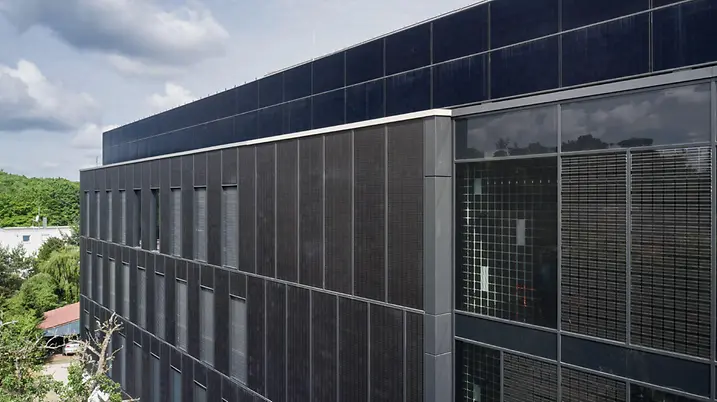
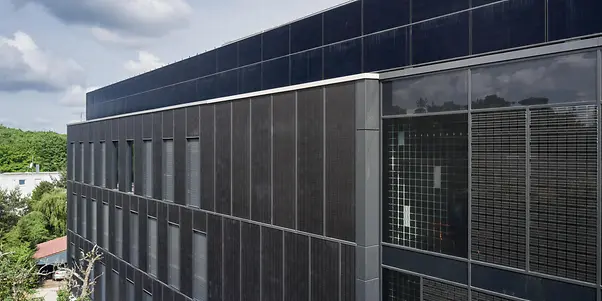
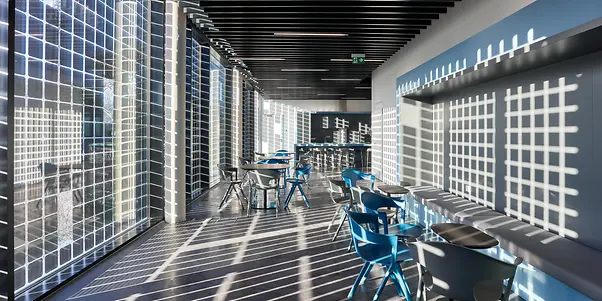
The Schüco BIPV, which is on almost 700 m² of the façade surface on the south and west sides of the building, has an output of around 70 megawatt hours per year. That is about 40 percent of the PV output. Both transparent, triple-glazed insulating glass BIPV modules with black monocrystalline cells and black monocrystalline BIPV glass-glass modules were used as opaque, foward-mounted units in front of the main façade. "The requirement to reduce the natural reflection of the PV modules along the motorway due to traffic safety concerns was a challenge," explained Marco Schech, the leading project engineer for BIPV at Schüco. "We then finally found a special cover glass which significantly reduced the reflection, thanks to its unusual surface structure, and fulfilled the official requirements." An interesting side effect is that the solar energy output through this special glass is actually 3% higher. 

Schüco Showroom Berlin

BIPV used as a design element

Schech is pleased that the niche topic of BIPV is currently gaining enormous momentum due to new political requirements and a rethink among clients and companies. BIPV is also growing in popularity amongst developers because building integrated photovoltaics nowadays enables even more interesting design effects and does not limit an architects creativity. "For the OWP 12 project the PV units had 32 different formats which is quite common. This is how BIPV nestles into the different window arrangements as well as outer and corner areas and follows the architectural form perfectly." David Schenke, architect and façade specialist at Drees & Sommer, can only confirm this, "Our design goal was to integrate the photovoltaics into the façade as a design element, without letting it dictate the visual appearance, and that has worked well for us. I am an architect at heart and I think that the BIPV façade from OWP 12 is a very aesthetic solution."

产品信息

BIPV

旭格Building Integrated Photovoltaics

为建筑实现可持续能源正输出的有效解决方案

为配合欧盟能源标识指令2010/31/EU,自2021年起,欧盟成员国的新建建筑必须符合“近零能源消耗”标准,极大提升能效平衡。在此前提下,德国致力于到2050年完成气候中立建筑经济建设。

因此旭格BIPV建筑光伏模块为符合可持续发展的未来建筑提供有效解决方案,使投资商、运营商获益,造福整个环境。

根据德国节能法规(EnEV),该模块产生的电能将从整个能源计算要求中减去,因此主要的能源需求量会降至最低。

在幕墙中使用BIPV模块不仅释放出环境保护和可持续发展的信号,也是实现近零能源消耗、零能源消耗或能源正输出建筑的关键组件。

了解更多​