BetaPort

A building system for the future

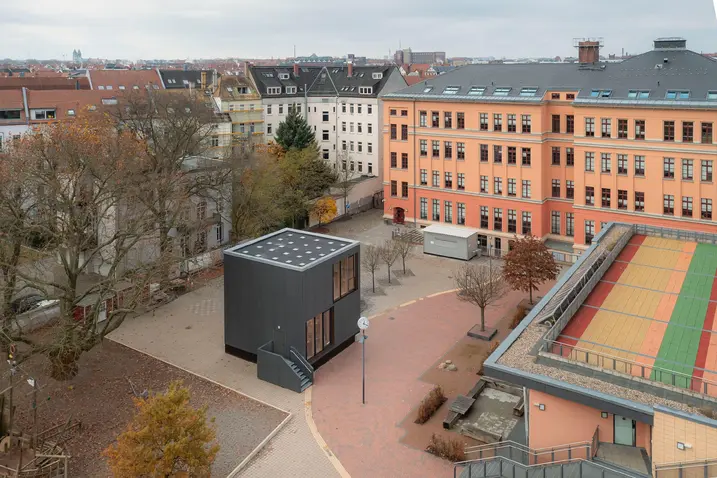
As an educational facility, the learning hub at the Leipzig International School is more than just a building. The underlying BetaPort construction system has a circular approach, which contributes to a sustainable and rewarding future. This was also made possible by using the Cradle-to-Cradle-certified window and sliding systems from Schüco.

Detaljer om referencen

Bygningstype Uddannelse og forskning
Produktkategorier Vinduer BIPV
Schüco-systemer BIPV AWS 75.SI+
Egenskaber Nybyggeri Dekarbonisering Energieffektivitet Cradle-to-Cradle Cirkularitet
Placering Leipzig, Germany
Færdiggørelse 2024
Arkitekter Urban Beta
Specialvirksomhed Steyer Glas + Metallbau GmbH
Billedkredit © Michael Moser Images

Flexible learning spaces

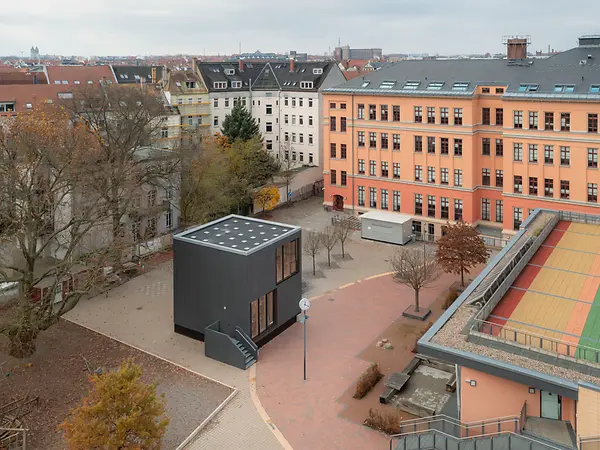
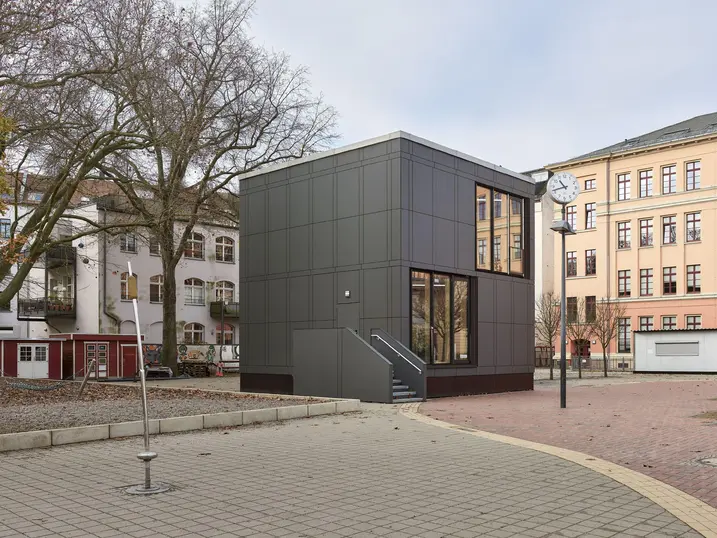
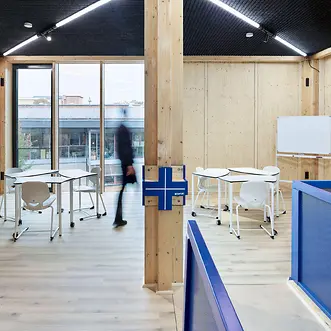
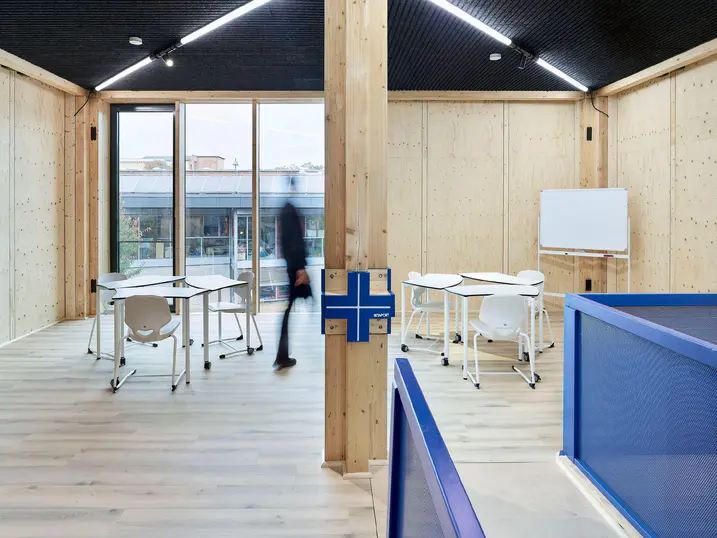
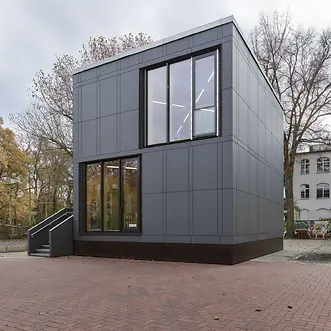
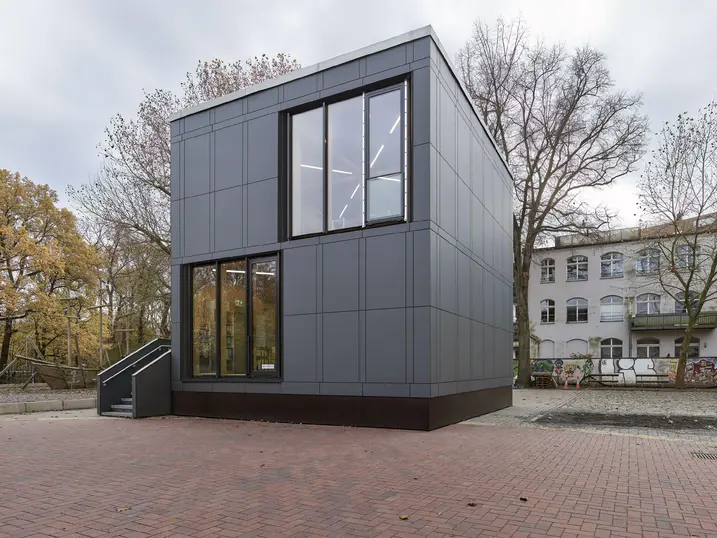
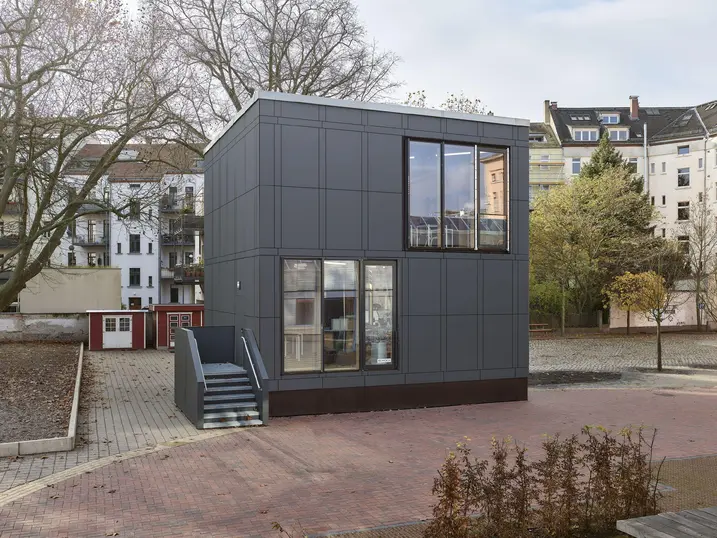
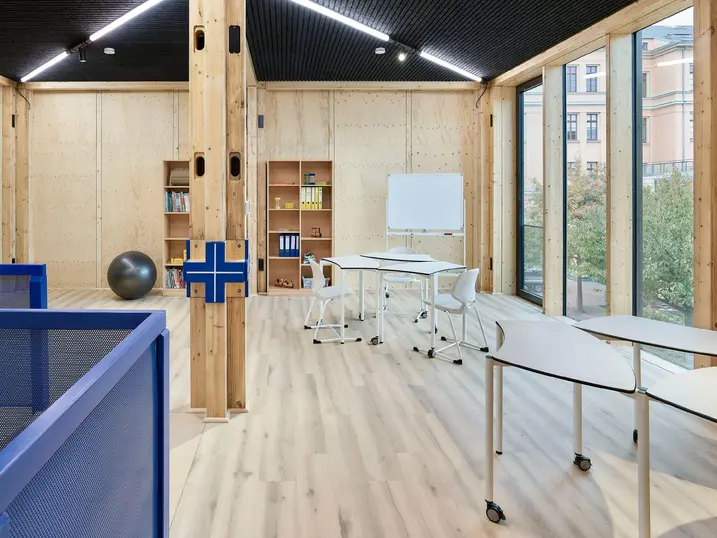
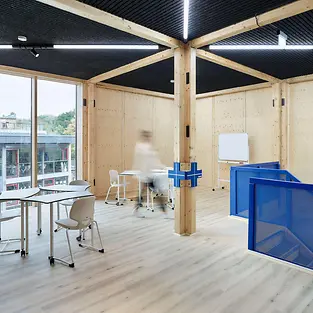
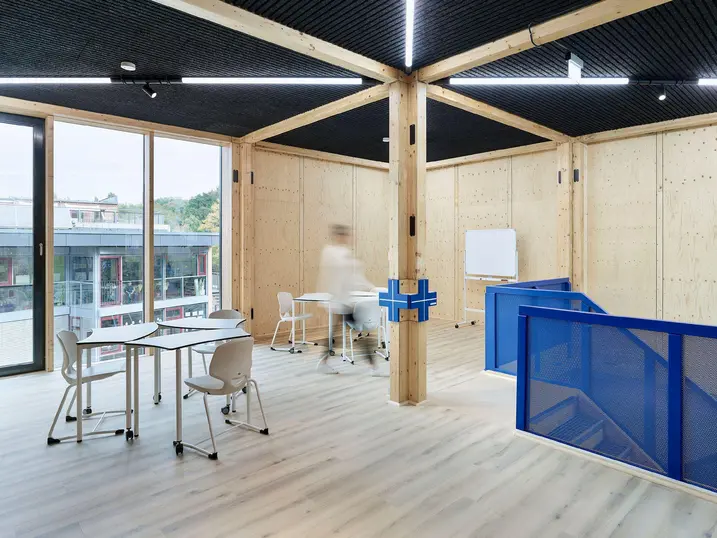
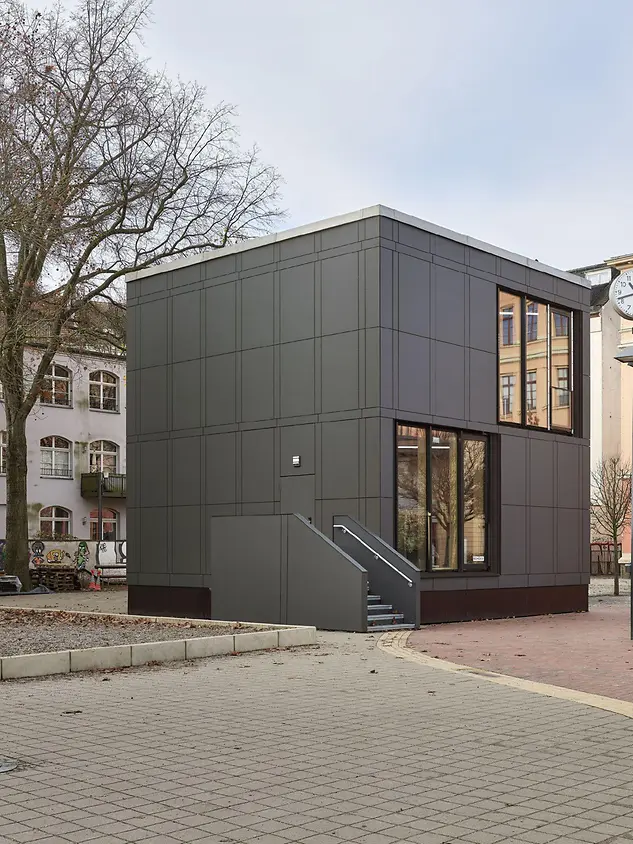
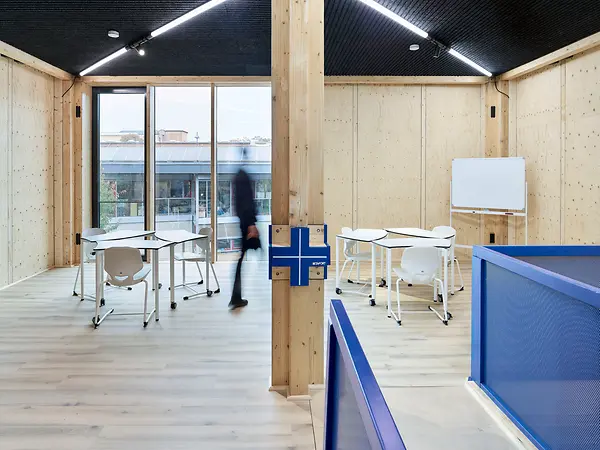
The idea for developing the BetaPort into a learning hub at the Leipzig International School came from the school itself. Conscious that a good education also requires a good educational infrastructure, the school directors were aiming to provide stimulating and flexible learning areas for the pupils whilst also looking to show sustainable handling of resources. Within three months, the timber-framed construction of the learning hub was established and able to offer groups of pupils and teachers a flexible and functional collection of rooms. Despite appearing closed from the outside, the modest cube contains purposefully placed floor-to-ceiling openings which allow a generous admission of daylight. Visible wooden surfaces and the lighting used support the pleasant atmosphere in the rooms. From quiet individual work to teaching small groups, the open-design floor plan allows for a number of different scenarios. 

DEMO Bild | Description Alterantive-Text

From a room to a circular and unitised building system

The BetaPort modular construction is based on a structurally rigid frame system with a grid of 5.40 m x 5.40 m. The hybrid system combines CLT ceilings with laminated timber beams and supports, enabling large spans and therefore providing a high level of flexibility within the internal space. Specially developed intersection points connect the load-bearing members and supports.This framework can be filled with different units in the sense of a modular building system – open, closed, as a small unit or a complex structure depending on its use. From the shell to the technical building services and expansion units, the well thought-out logic of the building components also significantly reduces the planning required. It was planned as a temporary construction with TÜV-certified components for which a building application could be submitted to convert it into a permanent building whilst the building is operational. The resulting room systems are both scalable and adaptable and can grow and shrink with their users.

Schüco in the building envelope

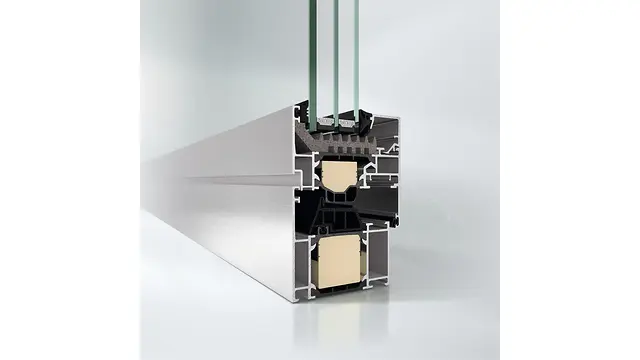
For the learning hub, the AWS 75.SI highly thermally insulated aluminium window system and the Schüco AOC 50 TI façade system have been installed on a timber substructure. This combines energy-efficient and aesthetically sophisticated construction with more streamlined fabrication and installation. The chosen configuration comprises window units with safety barrier spandrel glazing or balustrades. Building Integrated Photovoltaics (BIPV) are integrated in the glazed areas.

BIPV – design feature for sun shading and energy generation

Crystalline cells are embedded in the insulating glass as a semi-transparent design. The cells have been creatively arranged in a specific pattern, thereby delivering additional architectural quality. This provides sun shading and at the same time energy is being generated. With the ideal orientation and location, the number of BIPV units installed in this project can generate the same amount of electricity as a family home uses in an entire year. In the next development stage, the window profiles are integrated in the wooden frames, whereby the interfaces are always the same, irrespective of whether the infill units are opaque or transparent. The new Schüco Perfect window system was chosen for this. It offers a modular and flexible complete solution.

DEMO Bild | Description Alterantive-Text

Circularity thanks to the building component eco-system

The Design for Disassembly approach goes beyond the classic modular construction method. Every component of the building system has been designed to have a number of lifecycles, so that it can be re-combined up to ten times through a flexible and adaptable bolted connection system as finished, individually separable wall, floor and ceiling units. High quality and complete traceability must be guaranteed for the materials used in the building components through quality-controlled material partnerships and digitalised supply chains. This generates a building component eco-system, which supplies detailed information via the connected database about the construction of and materials used for the building components, as well as the operation site and maintenance cycles. By this process, it is possible to trace the materials from their original circulation to the end of their lifecycle.

The raw material reserves of the future

Efficient use of resources turns the learning hub into a raw material warehouse of the future, whose combination of renewable raw materials like wood and robust, durable aluminium constructions can be kept in the material cycle almost indefinitely. This circular approach makes a significant contribution to reducing CO₂ emissions in the construction sector. In order to take advantage of the potential for project-specific reductions in CO₂ from the level of building components to considering the lifecycle, solutions are being continually developed for the building envelope and its decarbonisation in the modular principle of Schüco Carbon Control. 

Building as a service

Instead of constructing buildings using protracted, linear processes, the BetaPort modular system relies upon flexible, recyclable building components with reversible connections. Today, 70% of the learning hub already consists of reused construction materials. The guarantee of return and reutilisation not only allows for swift construction but also enables a new leasing and financing model. A flexible subscription model and traceability of the components by means of blockchain technology open up the construction system to new service-based business models. The learning hub is being leased for three years initially with an option to buy and a possibility that the temporary building could become a permanent structure.

Produktinformationer

BIPV

Schüco Building Integrated Photovoltaics

Effektive løsninger til bæredygtig energiproduktion i bygninger

I overensstemmelse med EU's byggeretningslinje "2010/31/EU" skal hver ny bygning i EU-medlemslande fra 2021 opføres som en "næsten nulenergibygning" med en stort set kompenseret overordnet energieffektivitet. I denne sammenhæng sigter den tyske forbundsregering mod at gøre en klimaneutral byggeøkonomi til virkelighed i 2050.

Læs mere​

AWS 75.SI+

Schüco Vinduessystem AWS 75.SI+

Schücos velkendte standardserie, men i en superisoleret (SI) variant. Fremstillingsprocessen er desuden optimeret ved hjælp af SimplySmart-teknologien.

Schüco-vinduet AWS 75.SI+ er siden præsentationen i 2005 blevet en fast del af Schücos AWS 75 standardserie. For at leve op til fremtidens krav til lovgivningen samt markedets generelle ønske om mere effektive byggeprocesser, er Schüco-systemet AWS 75.SI+ ikke kun blevet energimæssigt optimeret, men giver med SimplySmart-teknologien tidsmæssige fordele ved fremstillingen.

Læs mere​