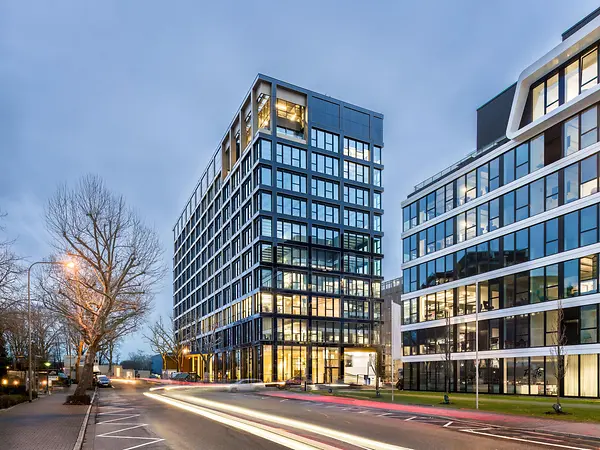
Building-integrated photovoltaics efficiently meets requirements

Since 2021, the EU Energy Performance of Buildings Directive (2010/31/EU) has required new buildings in the EU to meet the nearly zero-energy building standard. Schüco Carbon Control combines highly insulated building envelopes with building-integrated photovoltaics (BIPV). Depending on the specific design, use and site conditions, these solutions can improve overall energy efficiency and reduce energy consumption. This helps investors account for requirements relating to sustainable investments and energy-efficient buildings. Needs-based planning and use of the solar energy generated can lower energy costs and operational CO₂ emissions. As a result, the building can meet part of its own energy needs.​

Außenfassade mit integrierten Photovoltaikmodulen von Schüco

Operating sustainably with BIPV

A building with building-integrated photovoltaics (BIPV) can generate electricity on site. Depending on its design and actual operation, this can reduce the need to purchase externally generated electricity. It can therefore help lower the associated CO₂ emissions and operating costs. BIPV can be taken into account in several building certification systems, including DGNB, LEED and BREEAM. However, its specific contribution to the energy and CO₂ balance—and to profitability—depends on factors such as building design, location, orientation, shading, energy demand, system configuration and operating mode. It must therefore be assessed on a project-by-project basis.​

Versatile BIPV design options​

We offer a broad range of BIPV modules that can be configured for each project. Flexible system components support integration into Schüco façade systems, provided they are professionally planned and installed. Options for cell types, colours and glazing enable a variety of architectural applications. These include façades, rooflight structures, canopies and balconies.​

BIPV modules can support project-specific solutions. Depending on planning, material selection and the dismantling concept, they can also be incorporated into dismantling and recycling strategies. This makes it possible to combine architectural design, energy generation and lifecycle-oriented planning. In turn, this can support a long-term investment decision.​