Informations sur la référence
Type de bâtiment: |
Living |
Produits: |
Sliding doors |
Localisation: |
-, Portugal |
Achèvement: |
2018 |
Architecte: |
Janka Riedel |
Fabricant: |
- |
Crédits photos: |
© Leonard Witte |
Project details
Project details
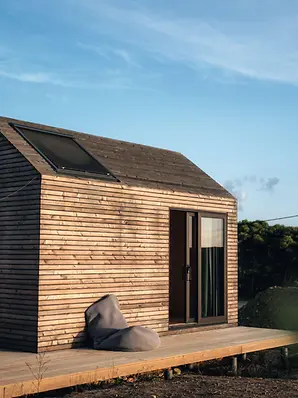
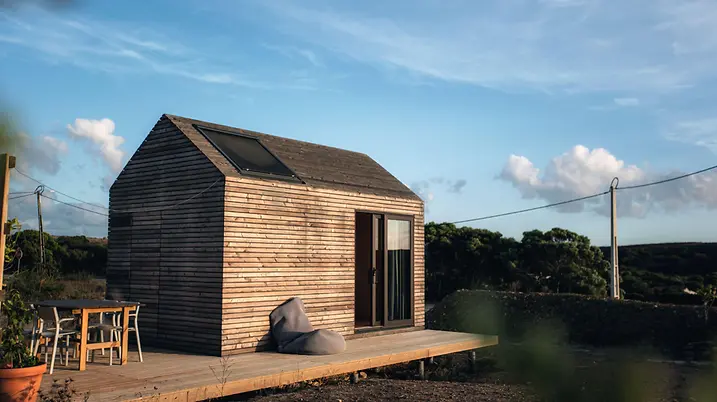
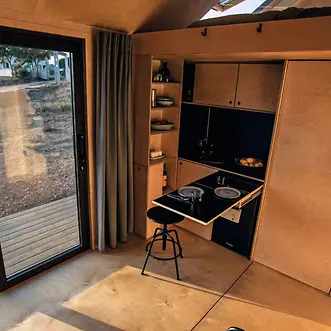
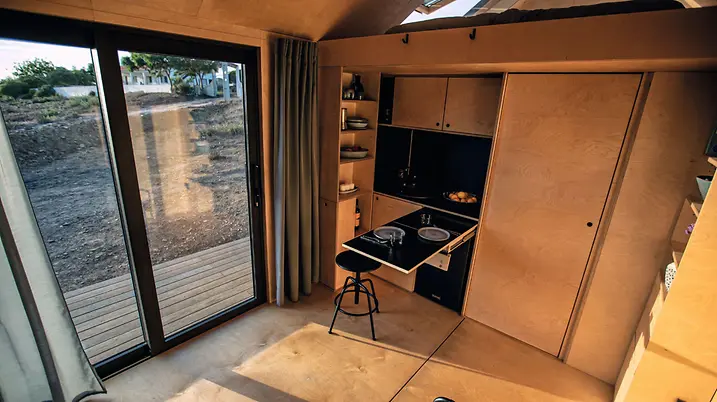
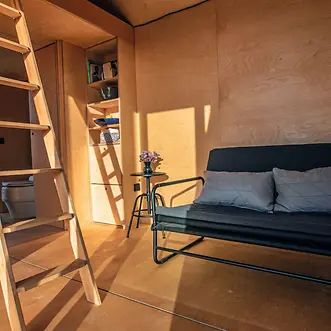
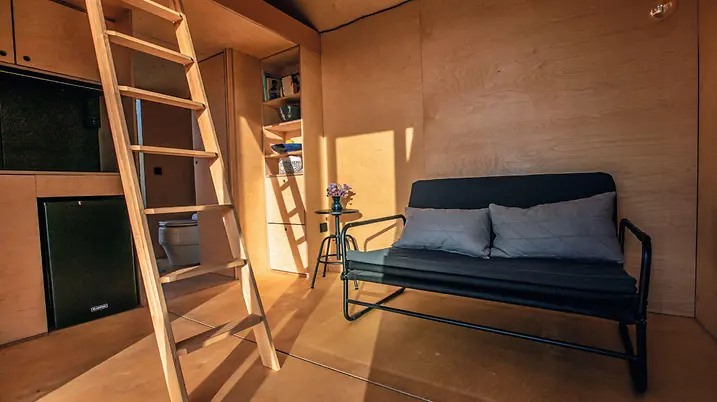
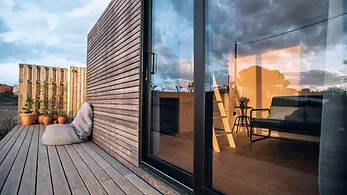
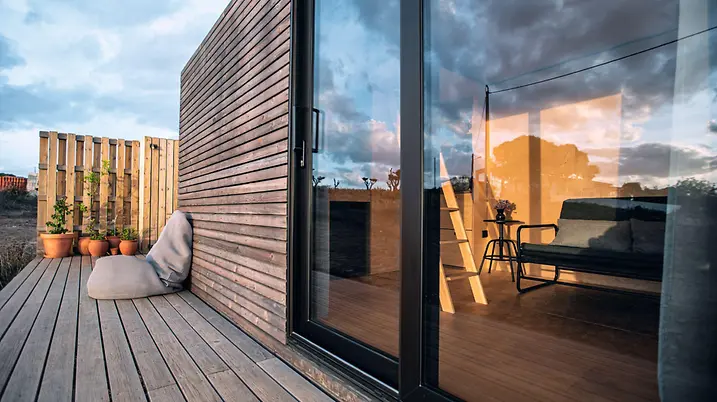
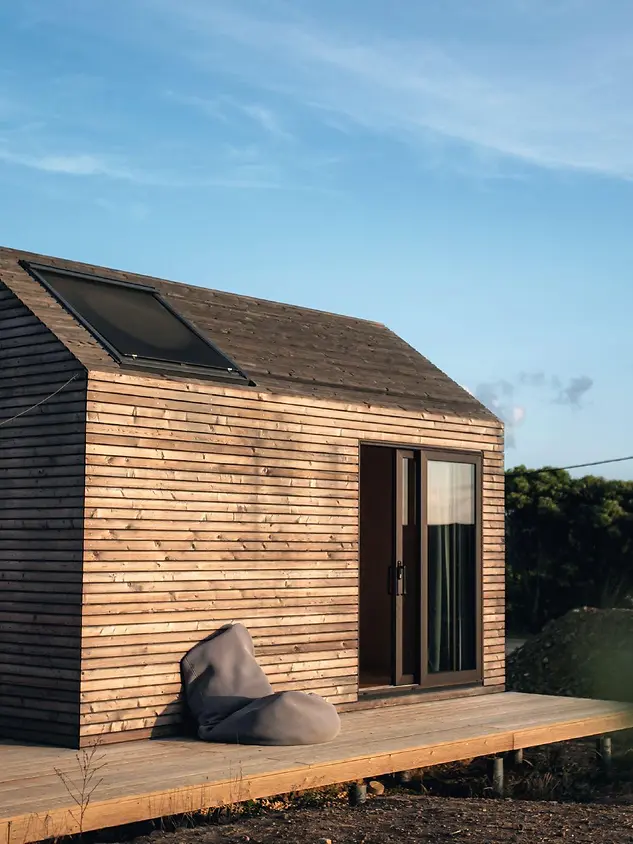
Living the simple life and reducing your house to a few square metres is a charming alternative to traditional visions of how one should live. For the architect, a passion for surfing, the desire for freedom and the possibility to work from any location were what first got her thinking about the things we really need to live and work. The result is a Tiny House measuring 14.3 square metres; a space that is shared not only by the sleeping, living, relaxing and working areas, but also by the kitchen and bathroom, and each area must function in its own right. In this small area, many diverse spatial scenarios are possible, which each create a different atmosphere depending on the time of day or night. The view is part of the concept. The large sliding door (Classic Design) connects the inside with nature, allowing you to gaze far off into the distance. This spatial extension is essential for the concept, conveying a feeling of endless freedom despite the compact floor plan.
Source: Profile magazine, issue 26
Download the profile 26 here (pdf, 8,4 MB)
You want to discover the variety of Schüco sliding doors? Click here and you can create the perfect sliding door for your building project.
An interview with the architect and client, Janka Riedel
What fascinates you about the idea of a Tiny House?
Janka Riedel: For a very long time, my work has been heavily project-based and very location-oriented, which made the idea of a mobile house simply the response to the question of what I really need to live and work. My degree in spatial strategies at the Muthesius University of Fine Arts and Design in Kiel, where the teaching combines architecture and cultural anthropology, was an excellent foundation for taking a new approach to the "why" and "how" questions.
What does that mean exactly?
Janka Riedel: There is the actual space with its four walls, and then there is also the “perceived” space. That is where the concept comes in. Despite the spatial overlap, the sleeping, living, relaxing, working, cooking and bathing areas must each function in their own right. In the Tiny House, all of these functions have a place within the 14.3 square metres.
What had to be taken into account during planning?
Janka Riedel: The basic idea was to create a transportable home. To achieve this, the Tiny House could be no larger than 2.40 metres wide and weigh no more than 3.5 tonnes. As inspiration, I looked at a range of prototypes with regard to resource consumption and sustainability, as the house would need to be adapted to the local climatic conditions.
How was your Tiny House built?
Janka Riedel: For the construction, I chose a system made from timber sandwich panels, with the openings for the door and windows already machined out in the factory. The solid construction responds to the climate, providing protection from heat in summer and cold in winter. The interior design, such as the sleeping level, the multifunction-al furniture and storage units, and the kitchen, were designed specifically for the house. My goal was to build the Tiny House myself – and I was able to do it with some help from colleagues and their workshops. All of the components were pre-installed in Germany and then assembled on site in Portugal. A façade made from horizontal larch wood panels surrounds the house and gives it a simple cubic look. As part of the ageing process, the larch wood will turn a shimmering silver colour.
Where is your favourite place in the house?
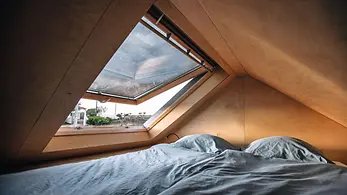
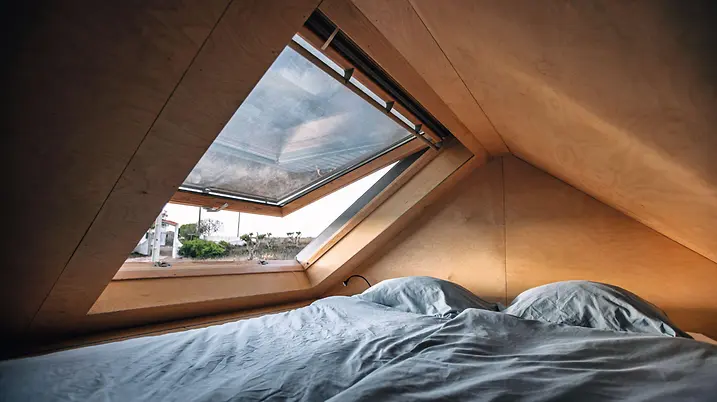
Janka Riedel: In this very small area, many different spatial scenarios are possible, which each create a wonderful atmosphere depending on the time of day or night. At night, my favourite place has to be the sleeping level, where you can look out through the roof window at the stars. But during the day, this space functions as a working and living area too. A tabletop is integrated into the kitchen cabinets, and also functions as a work area. This is where the ideas for new projects are created. The view is just beautiful. The large sliding door connects the inside with nature, allowing you to gaze far off into the distance. This spatial extension is essential for the concept, conveying a feeling of endless freedom despite the compact floor plan.
Do you ever think about living in a larger space again?
Janka Riedel: No, even four years on, I still feel at home in my Tiny House. I have so many ideas about how a new house could be further developed in terms of weight and design, to make it even more mobile (editor's note: the house is currently fixed to the floor, which is due to various local regulations), but also in terms of the ecological concept, such as the generation of energy and treatment of water, in order to become completely self-sufficient.
What advice would you give to anyone interested in a Tiny House?
Janka Riedel: Living in a very small space does not mean having to forsake comfort – but you must remember that there are no other private spaces like there are in a bigger home. My tip would be to try it out! That's the only way to get a feel for whether this type of lifestyle would actually suit you. And one last piece of advice – make sure you get in-volved with your own design ideas!
Thank you very much for talking to us.
Source: Panorama magazine, issue 3
Inspirations pour la référence
En tant qu'utilisateur enregistré, vous avez accès à votre espace de travail personnel.
- Nouveautés, sauvegarder les contenus
- Télécharger du matériel de travail (par exemple, textes d'appel d'offres, fichiers CAO, catalogues)
- Logiciels et outils
- Contact personnel