BetaPort

A building system for the future

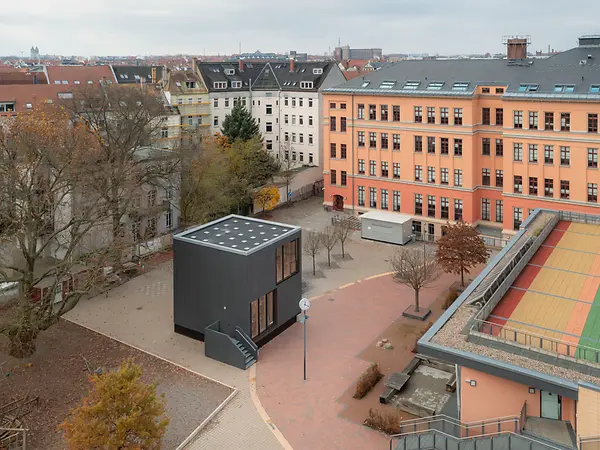
As an educational facility, the learning hub at the Leipzig International School is more than just a building. The underlying BetaPort construction system has a circular approach, which contributes to a sustainable and rewarding future. This was also made possible by using the Cradle-to-Cradle-certified window and sliding systems from Schüco.

项目案例详情

建筑类型 教育与研究
产品 BIPV(光伏一体化)
旭格系统 BIPV AWS 75.SI+
特征 新建建筑 脱碳 BREEAM认证 “从摇篮到摇篮”(C2C)认证 循环性
地点 Leipzig, Germany
竣工时间 2024
建筑师 Urban Beta
专业公司 Steyer Glas + Metallbau GmbH
图片版权 © Michael Moser Images

Flexible learning spaces

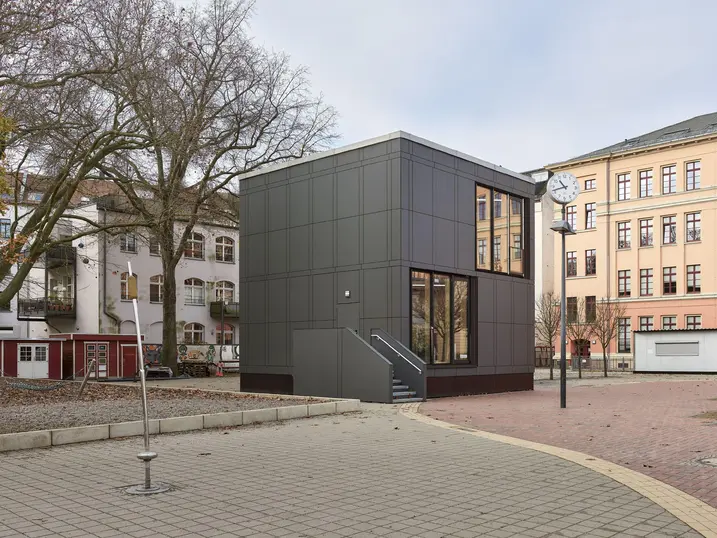
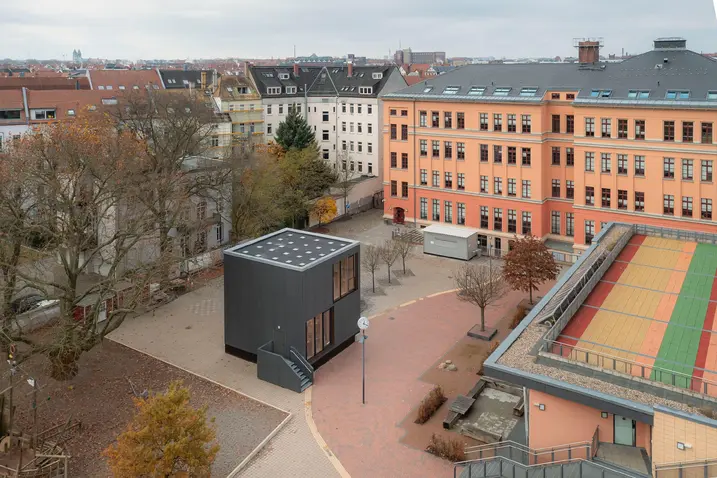
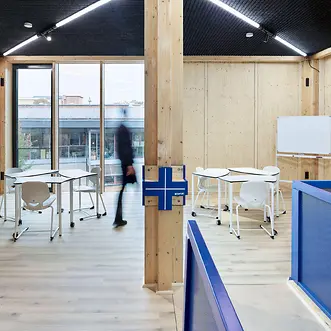
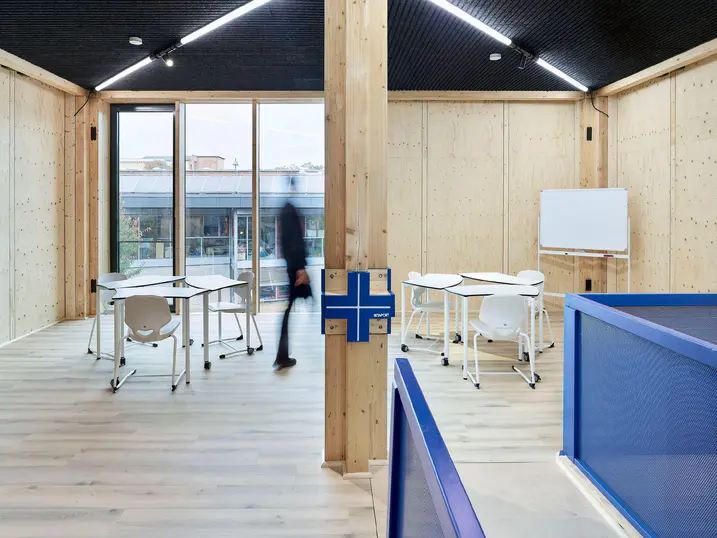
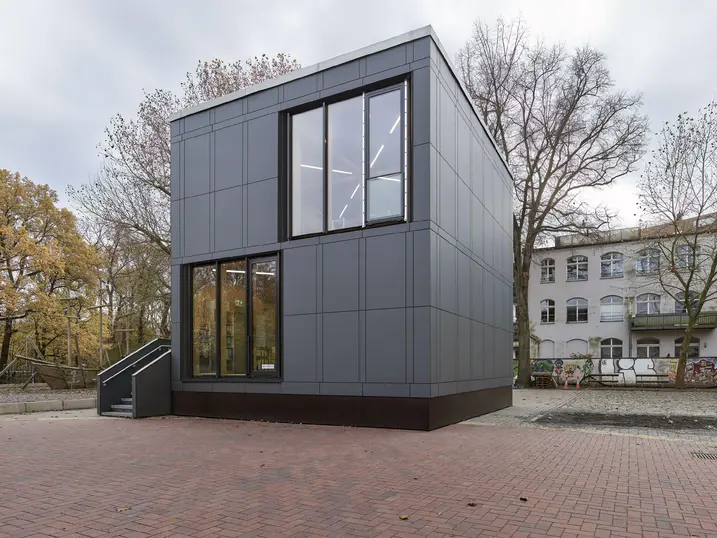
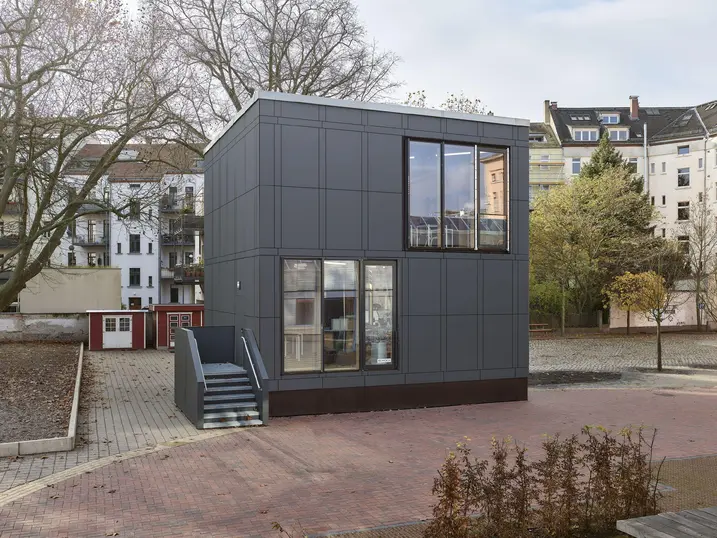
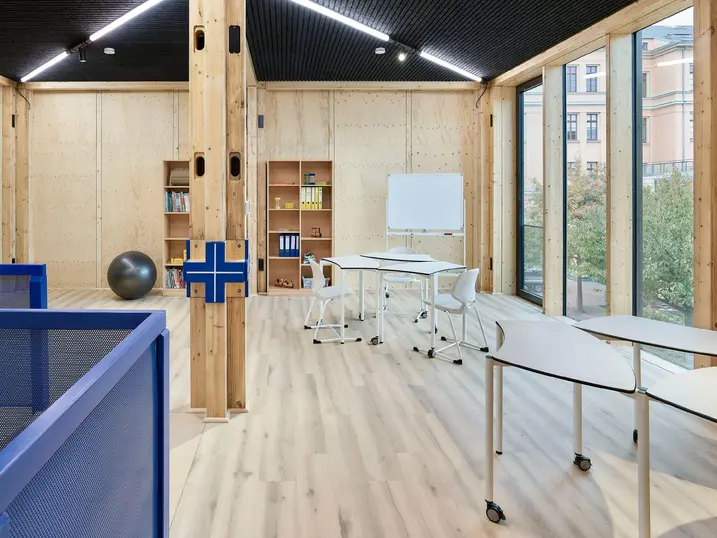
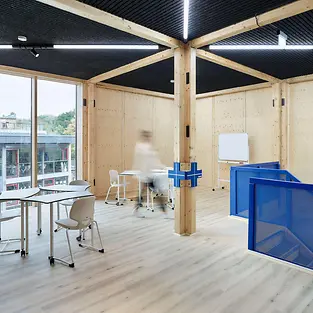
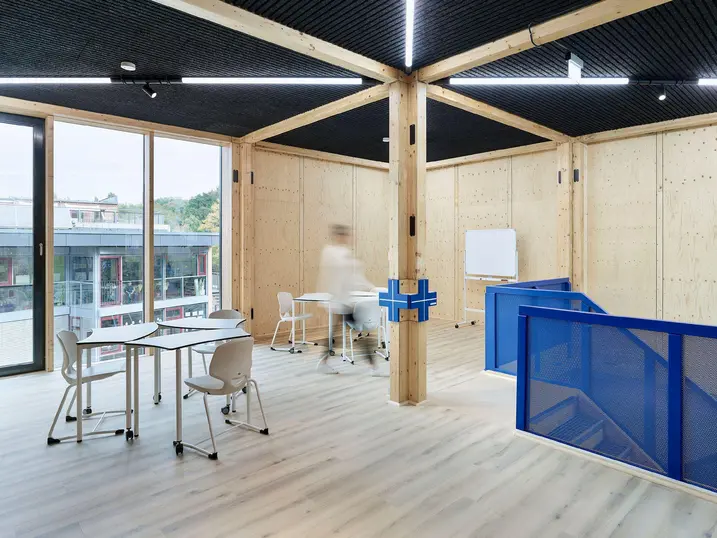
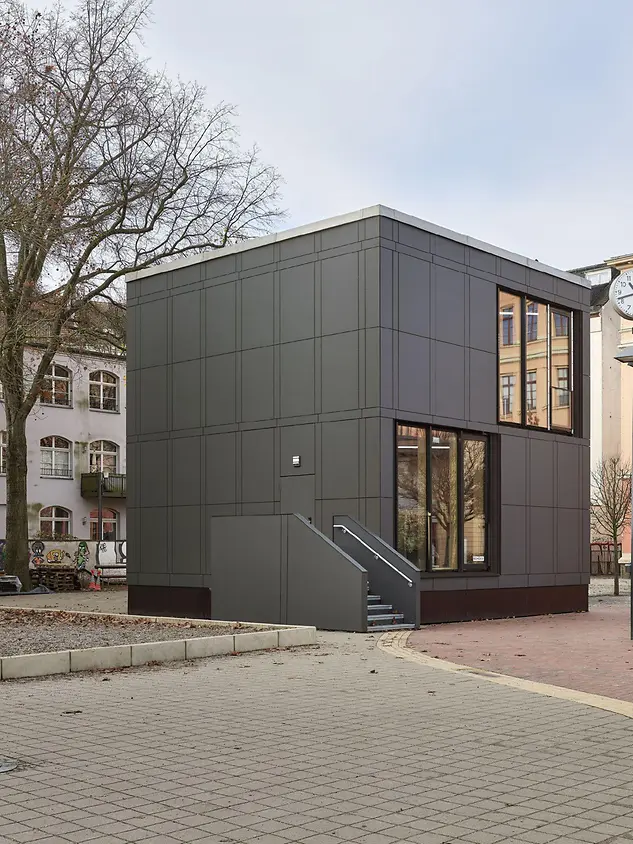
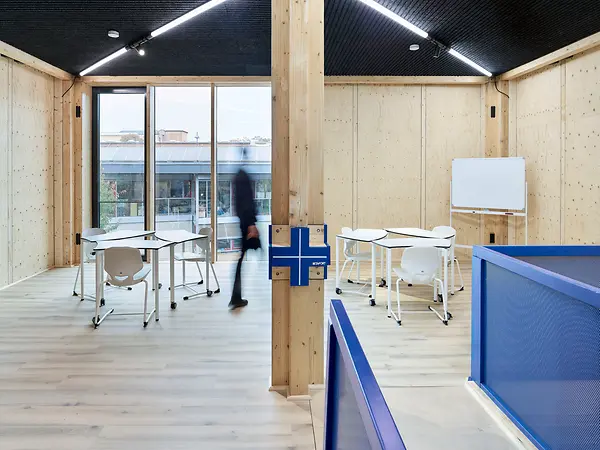
The idea for developing the BetaPort into a learning hub at the Leipzig International School came from the school itself. Conscious that a good education also requires a good educational infrastructure, the school directors were aiming to provide stimulating and flexible learning areas for the pupils whilst also looking to show sustainable handling of resources. Within three months, the timber-framed construction of the learning hub was established and able to offer groups of pupils and teachers a flexible and functional collection of rooms. Despite appearing closed from the outside, the modest cube contains purposefully placed floor-to-ceiling openings which allow a generous admission of daylight. Visible wooden surfaces and the lighting used support the pleasant atmosphere in the rooms. From quiet individual work to teaching small groups, the open-design floor plan allows for a number of different scenarios. 

DEMO Bild | Description Alterantive-Text

From a room to a circular and unitised building system

The BetaPort modular construction is based on a structurally rigid frame system with a grid of 5.40 m x 5.40 m. The hybrid system combines CLT ceilings with laminated timber beams and supports, enabling large spans and therefore providing a high level of flexibility within the internal space. Specially developed intersection points connect the load-bearing members and supports.This framework can be filled with different units in the sense of a modular building system – open, closed, as a small unit or a complex structure depending on its use. From the shell to the technical building services and expansion units, the well thought-out logic of the building components also significantly reduces the planning required. It was planned as a temporary construction with TÜV-certified components for which a building application could be submitted to convert it into a permanent building whilst the building is operational. The resulting room systems are both scalable and adaptable and can grow and shrink with their users.

Schüco in the building envelope

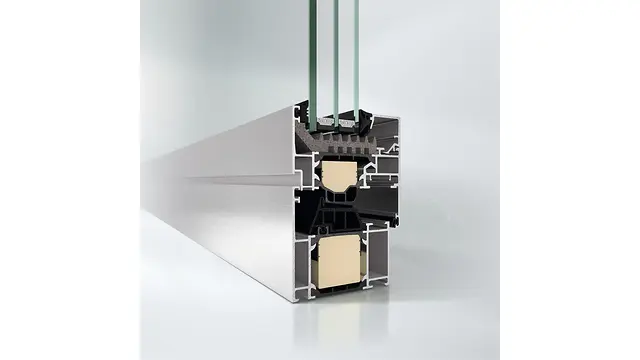
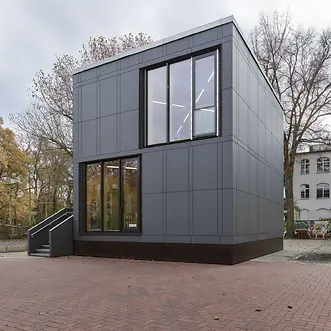
For the learning hub, the AWS 75.SI highly thermally insulated aluminium window system and the Schüco AOC 50 TI façade system have been installed on a timber substructure. This combines energy-efficient and aesthetically sophisticated construction with more streamlined fabrication and installation. The chosen configuration comprises window units with safety barrier spandrel glazing or balustrades. Building Integrated Photovoltaics (BIPV) are integrated in the glazed areas.

BIPV – design feature for sun shading and energy generation

Crystalline cells are embedded in the insulating glass as a semi-transparent design. The cells have been creatively arranged in a specific pattern, thereby delivering additional architectural quality. This provides sun shading and at the same time energy is being generated. With the ideal orientation and location, the number of BIPV units installed in this project can generate the same amount of electricity as a family home uses in an entire year. In the next development stage, the window profiles are integrated in the wooden frames, whereby the interfaces are always the same, irrespective of whether the infill units are opaque or transparent. The new Schüco Perfect window system was chosen for this. It offers a modular and flexible complete solution.

DEMO Bild | Description Alterantive-Text

Circularity thanks to the building component eco-system

The Design for Disassembly approach goes beyond the classic modular construction method. Every component of the building system has been designed to have a number of lifecycles, so that it can be re-combined up to ten times through a flexible and adaptable bolted connection system as finished, individually separable wall, floor and ceiling units. High quality and complete traceability must be guaranteed for the materials used in the building components through quality-controlled material partnerships and digitalised supply chains. This generates a building component eco-system, which supplies detailed information via the connected database about the construction of and materials used for the building components, as well as the operation site and maintenance cycles. By this process, it is possible to trace the materials from their original circulation to the end of their lifecycle.

The raw material reserves of the future

Efficient use of resources turns the learning hub into a raw material warehouse of the future, whose combination of renewable raw materials like wood and robust, durable aluminium constructions can be kept in the material cycle almost indefinitely. This circular approach makes a significant contribution to reducing CO₂ emissions in the construction sector. In order to take advantage of the potential for project-specific reductions in CO₂ from the level of building components to considering the lifecycle, solutions are being continually developed for the building envelope and its decarbonisation in the modular principle of Schüco Carbon Control. 

Building as a service

Instead of constructing buildings using protracted, linear processes, the BetaPort modular system relies upon flexible, recyclable building components with reversible connections. Today, 70% of the learning hub already consists of reused construction materials. The guarantee of return and reutilisation not only allows for swift construction but also enables a new leasing and financing model. A flexible subscription model and traceability of the components by means of blockchain technology open up the construction system to new service-based business models. The learning hub is being leased for three years initially with an option to buy and a possibility that the temporary building could become a permanent structure.

产品信息

BIPV

旭格Building Integrated Photovoltaics

为建筑实现可持续能源正输出的有效解决方案

为配合欧盟能源标识指令2010/31/EU,自2021年起,欧盟成员国的新建建筑必须符合“近零能源消耗”标准,极大提升能效平衡。在此前提下,德国致力于到2050年完成气候中立建筑经济建设。

因此旭格BIPV建筑光伏模块为符合可持续发展的未来建筑提供有效解决方案,使投资商、运营商获益,造福整个环境。

根据德国节能法规(EnEV),该模块产生的电能将从整个能源计算要求中减去,因此主要的能源需求量会降至最低。

在幕墙中使用BIPV模块不仅释放出环境保护和可持续发展的信号,也是实现近零能源消耗、零能源消耗或能源正输出建筑的关键组件。

了解更多​

AWS 75.SI+

旭格AWS 75.SI+窗系统

优化隔热性能、安防水准和加工流程

结构深度为75 mm的旭格AWS 75.SI+超隔热窗系统作为旭格AWS窗系统平台的一部分提供多样化的节能建筑外立面解决方案,满足不同应用需求。这个超隔热窗系统可按建筑设计要求作为洞口窗、带状窗、幕墙塞窗或与旭格门系统组合使用。

对开发商和建筑师还有另一项优势,该窗系统能实现多种开启类型,如内倾推拉、上亮下悬及垂直摆扇。

作为系统平台的组成部分,该窗系统提供众多的型材产品,例如组角竖框、结构竖框、对称和不对称竖框,此外还有各种设计类型以及更多与其他旭格产品的组合方案,例如与旭格遮阳系统或旭格通风系统组合。

这个引领未来的扩展系统基于“从摇篮到摇篮”(C2C)概念 — 适用于设计规划可持续发展建筑,使用经过有害物质和回收率检测评估的建筑组件:原材料制成的产品在使用寿命到期后经过回收能重新作为高品质材料循环使用。旭格AWS 75.SI⁺窗系统通过了汉堡环境保护促进协会(EPEA)的检测,符合美国C2C产品创新研究所颁布的现行C2C标准并获得了银奖证书。

了解更多​