Schüco Corporate Services

Choosing modernisation over newbuild

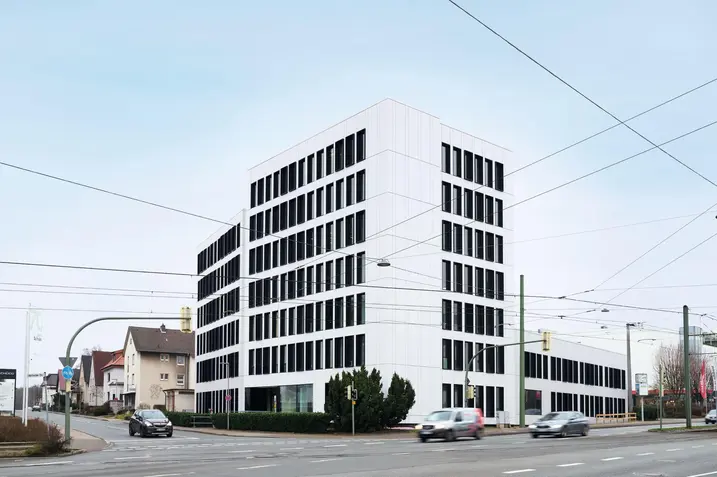
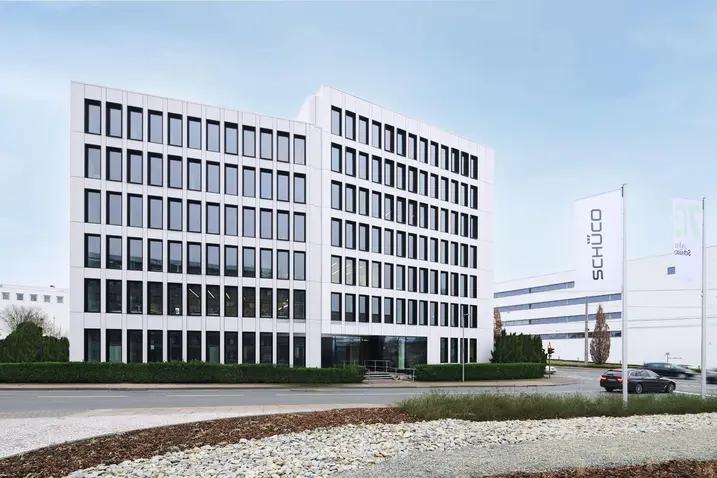
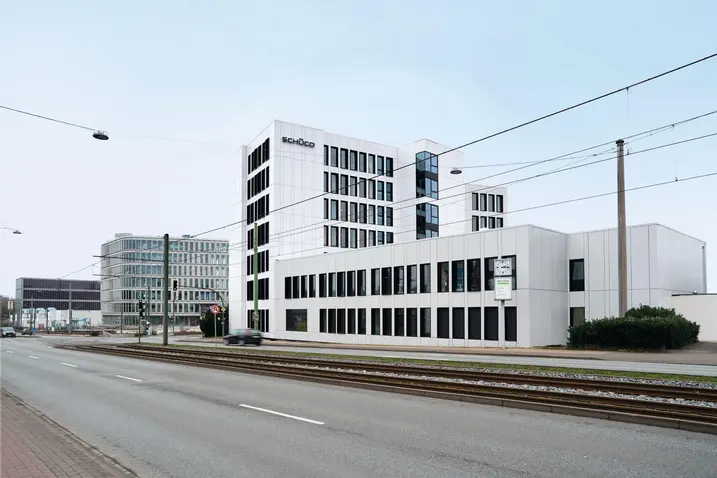
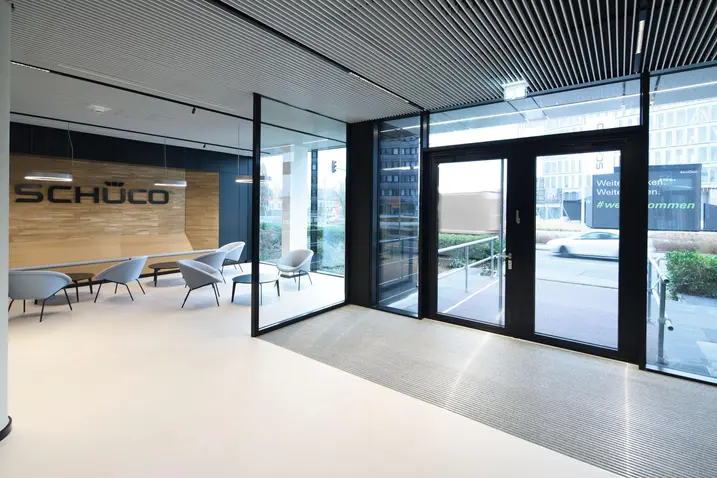
The Schüco Corporate Services building has been completely modernised from top to bottom. All of the aluminium components from the existing building were fed back into the raw material cycle to be recycled. In their place is now a Cradle-to-Cradle certified AF UDC 80 unitised façade, which gives the building a new lease of life. With regard to the office design, Schüco followed the concept of New Work, a forward-thinking approach to the workplace.

Details over het referentieproject

Gebouwtype Kantoor en administratie
Productgebieden Ramen Deuren Gevels FACID Ventilatie Zonwering Veiligheid Gebouwautomatisering
Schüco-systemen FWS 50.SI AWS 75 PD.SI AF UDC 80 ADS 80 FR 30 FWS 60.HI FWS 60 AD UP 75 AWS 75 BS.HI+ AWS 75.SI+ FACID 65 FWS 50 FireStop ADS 76.NI SP
Kenmerken Renovatie Energie-efficiëntie Cradle-to-Cradle Circulariteit
Locatie Bielefeld, Germany
Voltooiing 2021
Architecten tr.architekten Rössing-Tilicke
Gespecialiseerd bedrijf Hilzinger Metallbau
Informatie over de afbeeldingen Frank Peterschröder

A milestone on the company campus

The Schüco company headquarters has been expanded and restructured continually since 2016. One renovated building is the Digital Hub One office complex, a former production hall which has been modernised according to the principles of New Work, while newbuilds include the Schüco One building designed by architectural practice 3XN and the Schüco carpark with its striking textile façade. After three years of renovation work, the Schüco Corporate Services building was made available to its users, the Finance and IT departments, at the end of 2021.

Three building structures, one unit

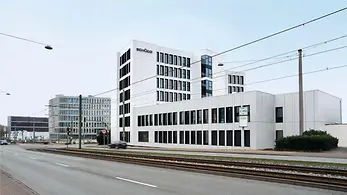
The complex is comprised of three building structures made of reinforced concrete: a seven-storey construction facing the future company headquarters Schüco One, a six-storey building along Karolinenstraße and a long, two-storey low-rise parallel to Herforder Straße. These three buildings were constructed one-by-one from the 1960s to the 1980s. In 2001, the façade of the complex, which was constructed as a Schüco ribbon window system, received a second suspended skin made of glass and aluminium. The interior of UZB, however, had remained largely unchanged, with its components more or less in their original condition. 

Fundamental restructuring

The main reason for the most recent conversion was the fact that the existing building fabric no longer complied with current fire protection requirements. While examining the building further, other technical and functional shortcomings were found, for example with regard to the service and sanitation systems and barrier-free access. Aesthetically speaking, the complex was also in need of an update. The colours of the interior had not been changed since the 1980s, and the suspended ceilings in the corridors and offices were outdated. To add to that, there was a lack of open workspaces and smart, inviting rooms for informal communication. It was clear to Schüco and the Cologne-based architectural practice tr.architekten, who were commissioned to create the design, that the complex was not only in need of technical renovations but would also require a complete refurbishment of the interior.

Geöffnete Schiebetür von Schüco mit Blick in den Wohnbereich

The New Work workplace concept

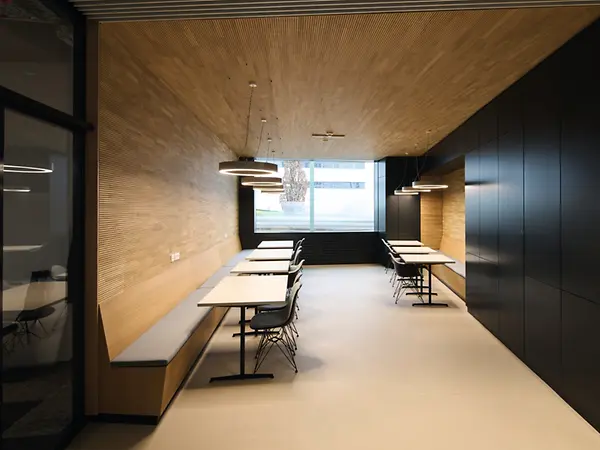
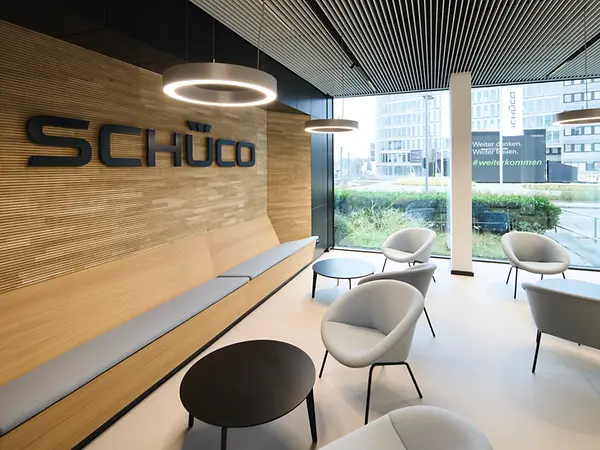
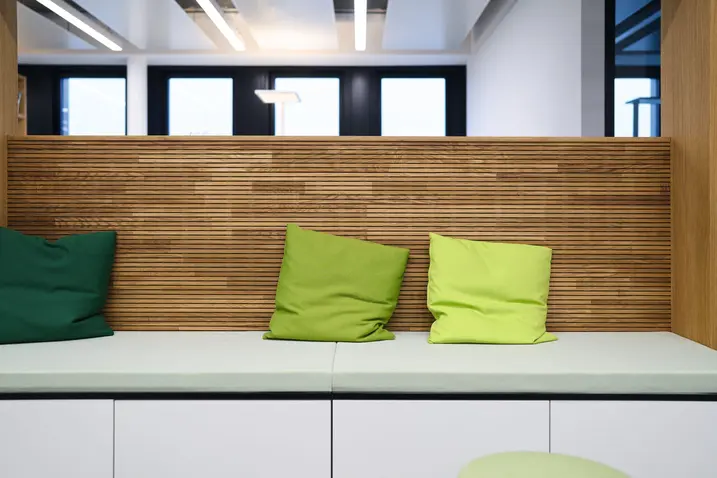
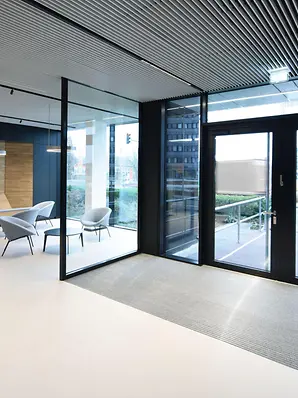
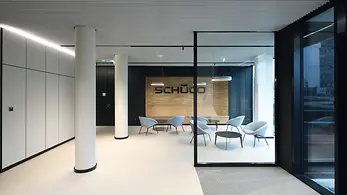
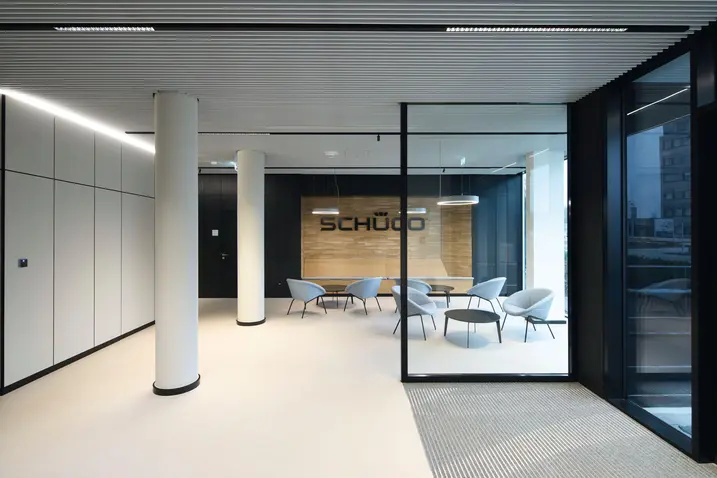
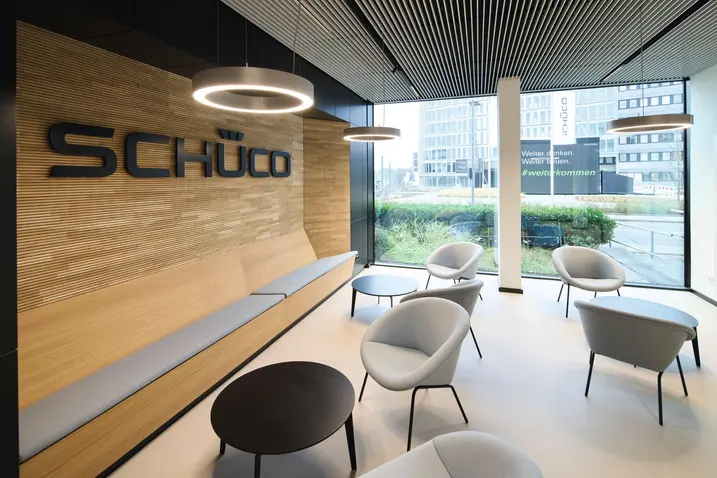
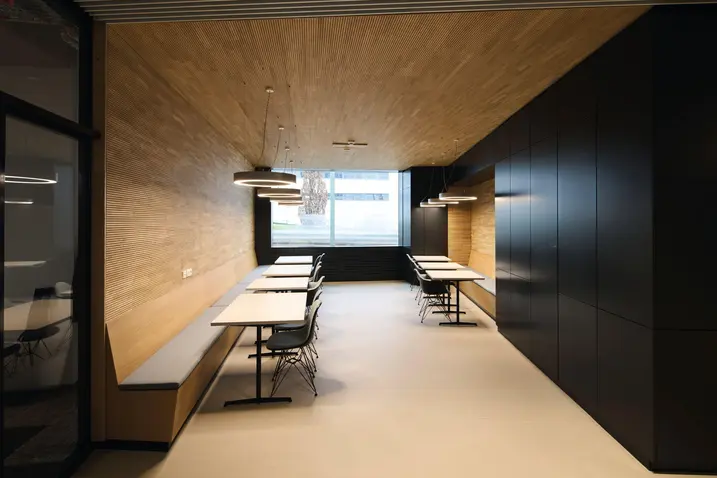
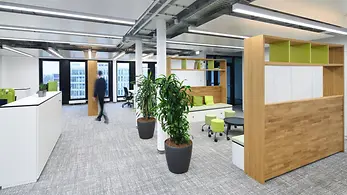
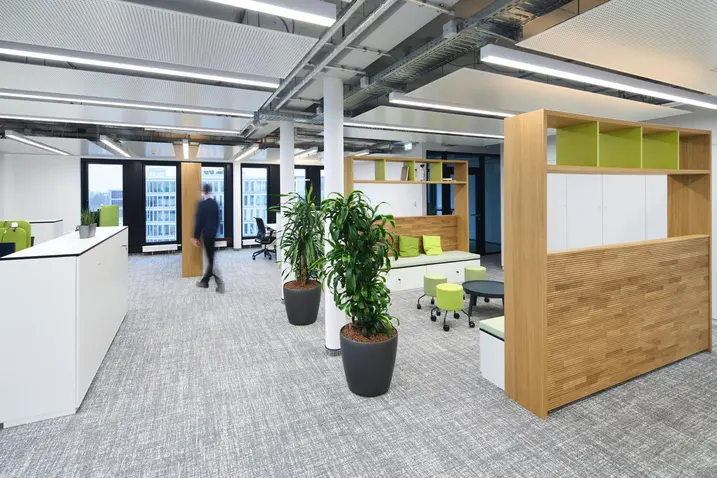
The design team approached the renovation in various stages. The office levels were completely redesigned in line with the principles of New Work. The areas are designed to accommodate 160 Schüco employees. Rooms for meetings with external auditors and tax advisors were also constructed. Open areas with the option of desk sharing, individual offices providing a quiet working environment, as well as meeting rooms and zones for informal communication alternate with one another in the floor plans. The end users of the complex were also involved throughout the design process, in order to increase acceptance of the new ways of working.

Acquired usable space

The reception and foyer and the staircases and lifts were also given a new lease of life. To do this, the existing lift shaft in the centre of the building was removed. A new lift was constructed at the intersection of the three building structures, at the rear-facing courtyard façade. The design team repurposed the extra usable space into open-plan communication zones.

A timeless building envelope

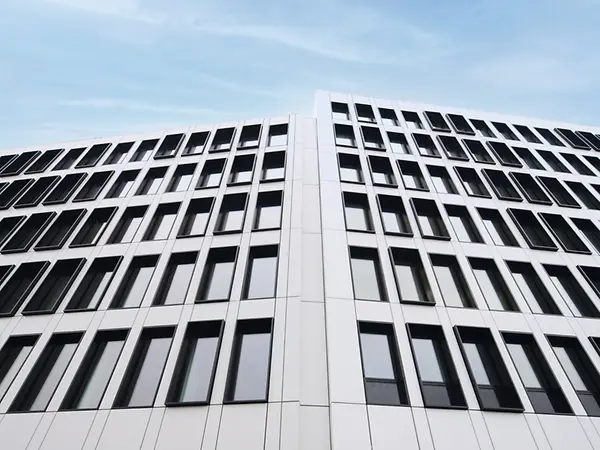
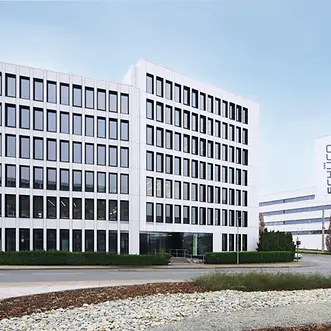
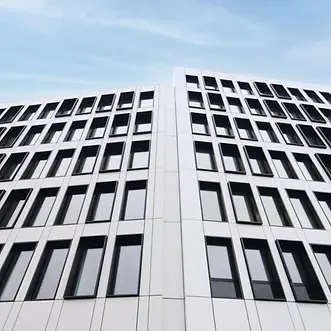
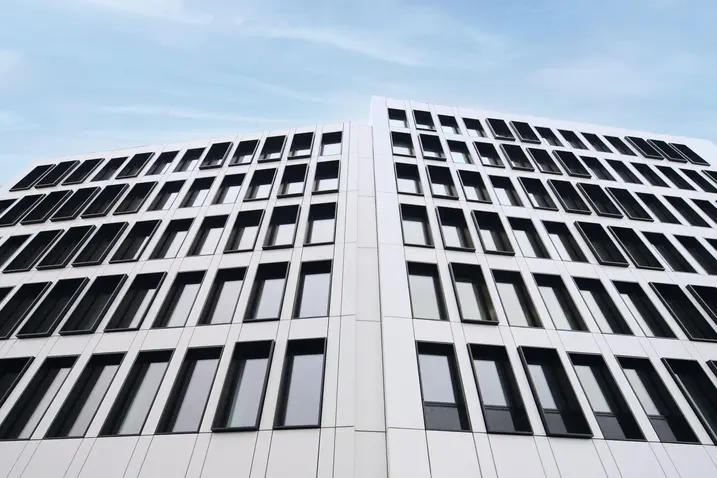
Another key element of the new design was to reinvigorate the façade, which required the existing aluminium components to be dismantled. "With the Schüco Corporate Services building, we've followed a holistic design approach," explains André Schreiber, the architect at Schüco responsible for the project. "This means that the façades should also be long-lasting and timeless. In keeping with the idea of showcasing as many of our products in use as possible on the campus, we have put the Cradle to Cradle-certified AF UDC 80 unitised façade to use for the very first time. "Even with the new building envelope, the three parts of the existing building are still recognisable as distinct structures. At the same time, the unitised façade lends them a muted, homogenous external appearance. In this way, the Schüco Corporate Services building offers a refreshing contrast to the bold and expressive design of the Schüco One newbuild opposite.

Geöffnete Schiebetür von Schüco mit Blick in den Wohnbereich

Project-specific details

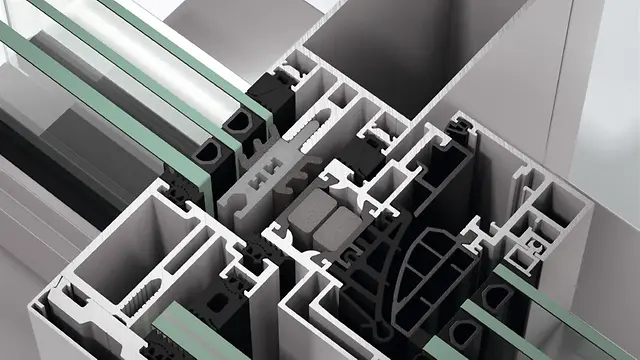
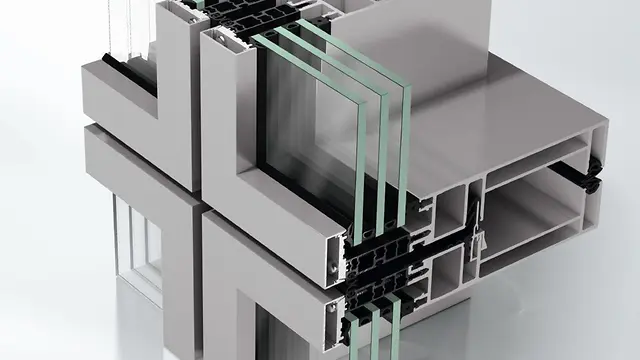
The unitised construction of the UDC 80 façade enables it to be easily adapted to any type of structural scenario and distribution of functions in the building. The façade of the Schüco Corporate Services building was assembled out of around 332 prefabricated units. Vent and panoramic windows, closed panel fields, and ventilation vents are alternated throughout the façade. For the first time, the Schüco AB ZDS (Aluminium Blind Zip Design Screen) sun shading system, which is an external, textile roller blind system, was integrated in the unitised façade.  The cover caps on the windows are another special detail of this project. These extend from the façade in three different lengths, creating a subtle play of shadows on the building envelope.

Back into the raw material cycle

As soon as the decision was made to renovate the façade, Schüco was determined to make recycling a priority. The existing façade of the complex from the 1980s and 2000s contained a large amount of aluminium. Schüco is also a founding member of the A|U|F, an association which organises a closed-loop recycling process for aluminium from the window, door and façade industry. It was natural, then, to dismantle all of the aluminium components from the façade and canopy, and feed them back into the A|U|F raw material cycle. In order to ensure that only aluminium was fed into the cycle, the company in charge of demolition collected the individual constituent materials in separate containers as much as possible. The aluminium was then recycled in several container loads by companies belonging to the A|U|F. In total, 28 tonnes of the material were extracted from the building, which was confirmed by European Aluminium (EA) following an external audit, which confirmed a recycling rate of 98.3%.

Geöffnete Schiebetür von Schüco mit Blick in den Wohnbereich

Recycling rates recorded for the first time

In 2014, the EA began to survey the recycling rate of different buildings in Europe following demolition or renovation in order to independently confirm high recycling rates of aluminium. This figure is also used in the basic assumptions when calculating an Environmental Product Declaration (EPD). Before long, the EA began a new way of measuring recycling rates. They called on their members to name projects that would verify their recycling rates. Schüco answered this call. The audit results from the Schüco Corporate Services building were the first to be included in this new survey. 

A holistic approach

In addition to the UDC 80, other C2C Silver-certified products were used such as the FWS 50 / 60 SG mullion/transom construction for the entrance façade, the AWS 75 BS insert units and the AD UP 75 doors. Following the renovation, the building now meets the ambitious KfW 70 standard and consumes 265,000 kWh less primary energy per year than before as a result. The renovated building is supplied with certified green energy and receives heating energy and hot water via district heating.

Building materials from renewable resources

The roofs, for instance, are insulated with cellulose fibres. A green roof is also in the works. This 500 m² green space will encourage insect diversity, improve the microclimate both in and around the building, and reduce noise and pollution. The construction companies similarly took precautions to minimise pollution and noise while they worked on the building. Schüco chose to work predominantly with local businesses to reduce time spent on construction and on transporting materials. The project is being subsidised by the Ministry for the Environment, Conservation, Agriculture, and Consumer Protection in the state of North Rhine-Westphalia. 

Productinformatie

FWS 50.SI

Schüco Gevelsysteem FWS 50.SI

Passiefhuis-gecertificeerde vliesgevel voor gevarieerde oplossingen

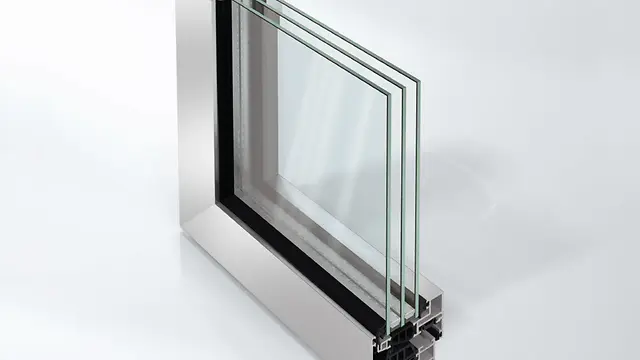
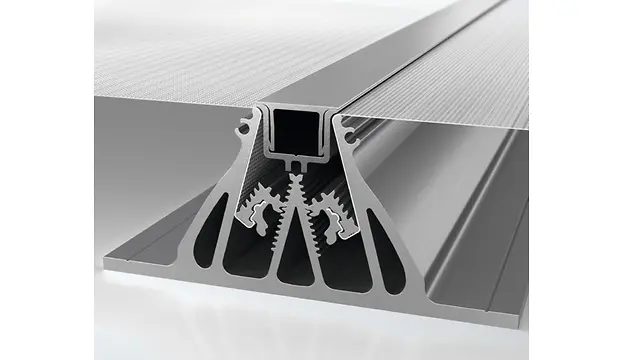
Gebaseerd op baanbrekende isolatietechnologie, biedt het Schüco Vliesgevelsysteem FWS 50.SI (Super Insulated) extreem goede thermisch geïsoleerde oplossingen voor de uitvoering van veelzijdige vliesgevels en lichtdaken op passiefhuisniveau - inclusief geoptimaliseerde productie- en montageprocessen.

Meer informatie

AWS 75 PD.SI

Schüco Raamsysteem AWS 75 PD.SI

Maximale transparantie dankzij de minimale aanzichtbreedtes

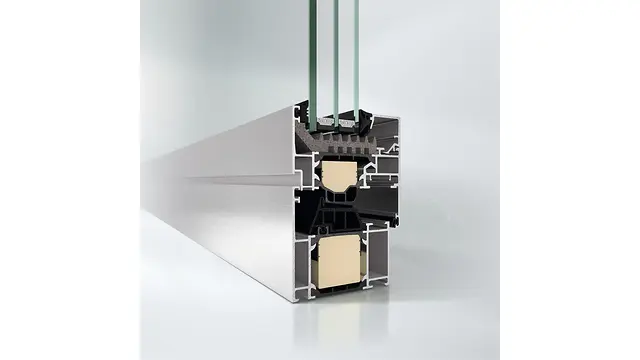
Naast energie-efficiëntie is het samengaan van vorm en functie vandaag de dag een vereiste voor de realisatie van moderne geveloplossingen. Met het raamsysteem Schüco AWS 75 PD.SI (Panorama Design Super Insulated) biedt Schüco als eerste een openingselement aan dat perfect aan deze architectonische eisen voldoet: met minimale interne en externe zichtbare breedtes en uitstekende thermische isolatie.

Meer informatie

AF UDC 80

Schüco Gevelsysteem AF UDC 80

Dynamische elementgevel met grote ontwerpvrijheid

Het Schüco Vliesgevelsysteem AF UDC 80 (Aluminium Façade Unitized Dynamic Construction) maakt deel uit van het systeemplatform voor aluminium elementgevels Schüco AF UDC 80. Met zijn schaalbare en geteste assemblages biedt het dynamische systeem architecten en constructeurs een eenvoudige realisatie van bouwprojecten in een elementaire constructie, met een breed scala aan toepassingen en ontwerpen gebaseerd op rationele planning en verwerking.

Meer informatie

ADS 80 FR 30

Schüco Veiligheidssysteem Deur ADS 80 FR 30

Deur- en wandconstructie voor multifunctionele brand- en rookwerende toepassingen

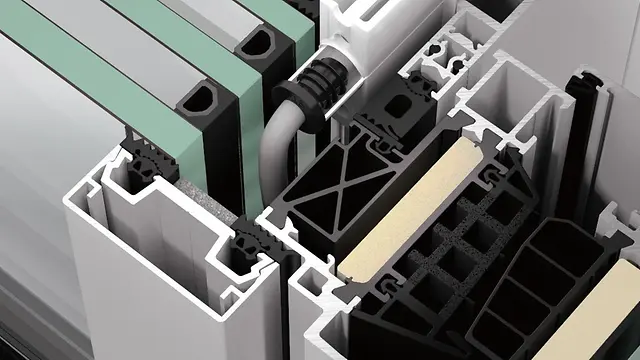
Het beproefde Schüco ADS 80 FR 30 (brandwerende) deursysteem op basis van zeer sterke 5-kamer holle profielen met een bouwdiepte van 80 mm maakt indruk met zijn veelzijdigheid in gebruik, functie en design.

Meer informatie

FWS 60

Schüco Gevelsysteem FWS 60

Betrouwbare vliesgevel met 60 mm aanzichtsbreedte, de basis voor een breed scala aan oplossingen

Het Schüco vliesgevelsysteem FWS 60 maakt indruk als basissysteem voor vliesgevels en lichtdaken met een hoge flexibiliteit en aantrekkelijke ontwerpopties, inclusief geoptimaliseerde productie- en montageprocessen. Dankzij een breed programma systeemprofielen kunnen oplossingen voor een breed scala aan eisen en toepassingen worden gerealiseerd.

Meer informatie

AD UP 75

Schüco Deursysteem AD UP 75

Universeel gebruik als zowel hoogfrequent gebruikte toegangsdeur en designhuisdeur

Uitstekende isolerende eigenschappen gecombineerd met hoge stabiliteit: het Schüco deursysteem AD UP 75 met een bouwdiepte van 75 mm biedt een hoge functionele betrouwbaarheid voor alle vereisten voor hoge woon- en kantoorgebouwen.

Meer informatie

AWS 75 BS.HI+

Schüco Raamsysteem AWS 75 BS.HI+

Zeer goed geïsoleerde blokramen met verdekte vleugel voor uitgekiende ontwerpeisen

Met uitstekende thermische isolatiewaarden en een slank ontwerp zonder zichtbare vleugelcontouren, voldoet Schüco AWS 75 BS.HI + (Block System High Insulated) aan de hoogste energie- en architecturale eisen met de grootst mogelijke transparantie.

Meer informatie

AWS 75.SI+

Schüco Raamsysteem AWS 75.SI+

Een pluspunt in isolatie, betrouwbaarheid en verwerking

Het geoptimaliseerde standaard Schüco AWS 75.SI+ (Super Insulated) raamsysteem met een diepte van 75 mm maakt deel uit van het Schüco AWS systeemplatform en vormt de basis voor een breed scala aan toepassingen in energiezuinige gebouwen. Afhankelijk van de architectonische vereisten kan het sterk thermisch geïsoleerde aluminium systeem worden gebruikt als gatvullend raam, raamstrook, inzetelement in een vliesgevel of in combinatie met de Schüco-deursystemen.

Meer informatie

FACID 65

Schüco Gevelsysteem FACID 65

Multifunctionele gevel van textiel met een breed scala aan toepassingen en ontwerpen

Duurzaam bouwen omvat steeds meer de volledige levenscyclus van het gebouw: dit betekent dat de eisen aan de functionaliteit en flexibiliteit van gevels gestaag toenemen. Met de Schüco FACID 65 textielgevel kan het uiterlijk van een gebouw snel en efficiënt worden aangepast aan veranderende eisen zonder functionele beperkingen, een belangrijke mijlpaal op weg naar een transformatieve gevel.

Meer informatie

FWS 50

Schüco Gevelsysteem FWS 50

De veelzijdige vliesgevel met 50 mm aanzichtbreedte, de basis voor een breed scala aan oplossingen

Het Schüco vliesgevelsysteem FWS 50 maakt indruk als basissysteem voor vliesgevels en lichtdaken met een hoge flexibiliteit en aantrekkelijke ontwerpopties, inclusief geoptimaliseerde productie- en montageprocessen. Dankzij een breed programma systeemprofielen kunnen oplossingen voor een breed scala aan eisen en toepassingen worden gerealiseerd.

Meer informatie

FireStop ADS 76.NI SP

Schüco Deursysteem FireStop ADS 76.NI SP

Niet-geïsoleerd rookwerend systeem met hoge flexibiliteit

Het niet-geïsoleerde rookwerende deursysteem Schüco FireStop ADS 76.NI SP (Non Insulated Smoke Protection) met zijn innovatieve éénkamerprofiel met open sponning is gebaseerd op het Schüco FireStop-platform - dit zorgt voor een hoge mate van flexibiliteit bij de planning en de bouw.

Meer informatie