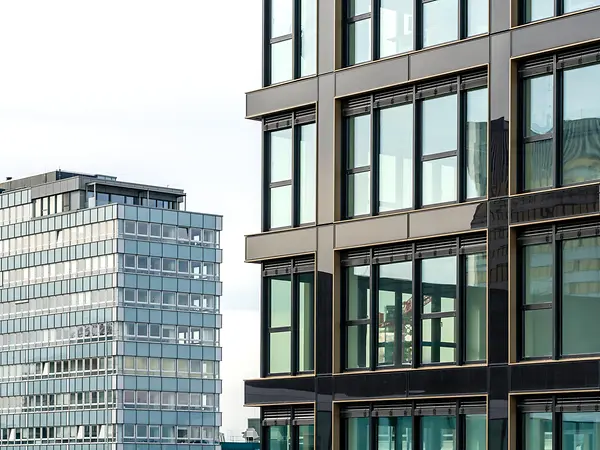
Circular economy – harnessing potential.

When it comes to transforming the construction sector at product and system level, several factors have been identified: material efficiency, material substitution and the circular economy. As a sustainable alternative to the traditional, linear economic model (take-make-waste), the circular economy offers the greatest impact. This is achieved through product design that focuses on longevity, repair, maximising resource efficiency and minimising waste, as well as closing material cycles through recycling.
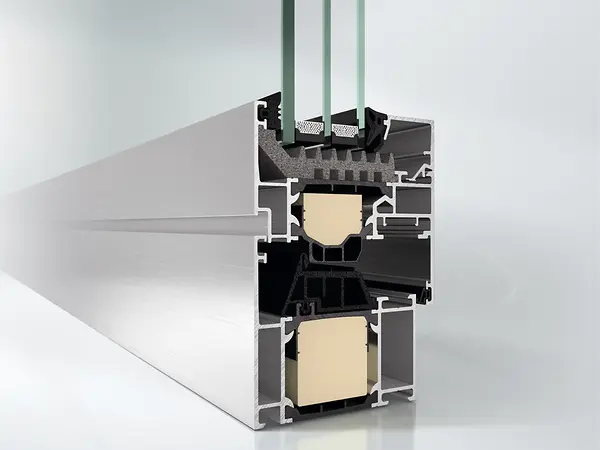
100_102723_AWS_75_SI_plus_s

Strategies for resource-friendly product design

Schüco develops durable products that minimise material consumption and waste. The modular construction enables replacement of defective parts or integration of new technologies without having to replace the entire product. Products designed according to the Cradle-to-Cradle principle can be dismantled into individual parts at the end of their usage phase, making it easier to recycle or reuse them. The establishment of suitable recycling processes on an industrial scale is also a basic requirement for a true circular economy. Schüco systems offer helpful support for planning a building project in accordance with the fourth environmental aim of the EU taxonomy (the transition to a circular economy): they attest to the harmlessness of the materials, the economical use of water and energy, and adherence to social standards.The Cradle-to-Cradle portfolio from Schüco is continuously expanded to optimise sustainability, design and budgets.

Ultra Low Carbon Profil von Schüco

Aluminium and value retention

Aluminium is known not only for its longevity and corrosion resistance, but also for its recycling properties. The material is suitable for use with the Cradle-to-Cradle principle for multiple reasons:

  • Aluminium is light yet stable, which reduces material consumption and extends the lifespan of products.
  • Aluminium is almost fully reusable and can be kept in a virtually unending loop without any loss of quality when recycled properly.
  • No other industry has comparably high quality requirements for aluminium grades as the construction industry. This means, for example, that aluminium windows can be downcycled into packaging material, but lower material grades cannot be turned into an aluminium profile.
  • As an inert material, aluminium does not release any harmful substances, which is important when it comes to Cradle-to-Cradle certification. As a founding member of A|U|F, Schüco has been committed to the environmentally-friendly recycling and reuse of aluminium since 1995.
Bürohaus mit Photovoltaikfassade in Eschborn

Measurablility and indicators

The measurability of a product's environmental performance is a key aspect of the circular economy. The lifecycle assessment (LCA) along a complete process chain, from production and construction through to use and disposal, is a starting point for a comprehensive assessment of carbon intensity. This enables an extensive, consistent examination of the environmental impact, far beyond the existing analysis of the efficiency of building operations. Lifecycle assessments are currently being used primarily in building certification and for conformity with the EU taxonomy.