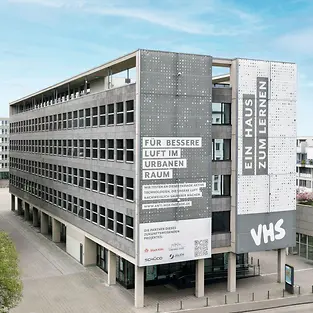
Volkshochschule Cäcilienstraße

Textile façade filters out over 30% of nitrogen oxides from the air

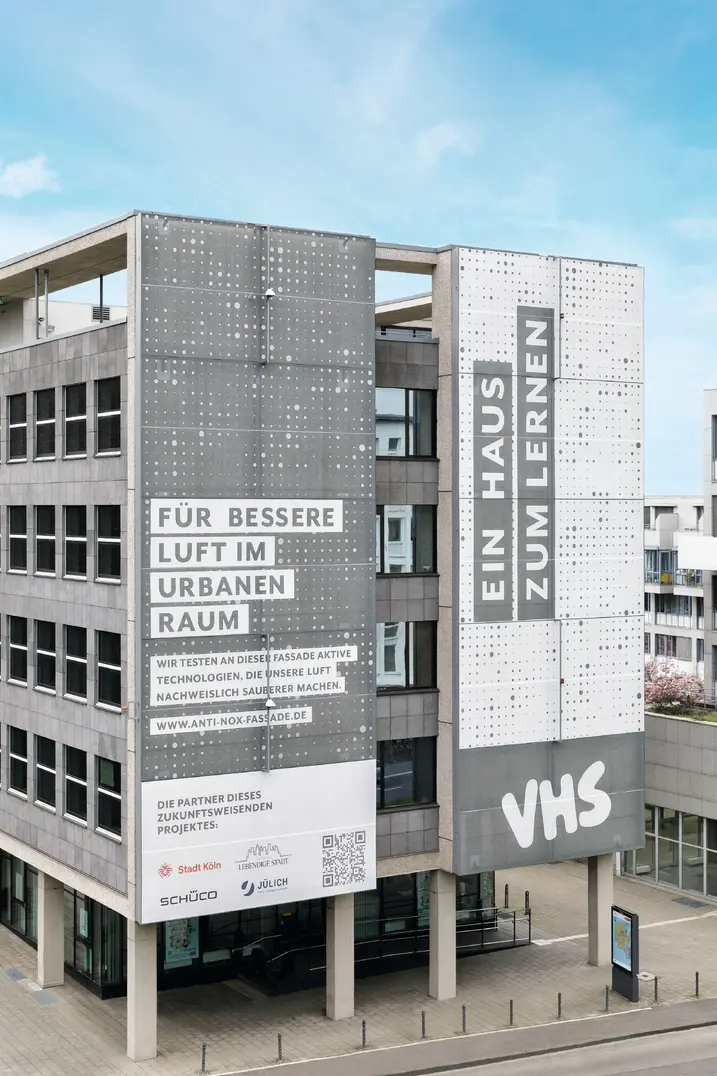
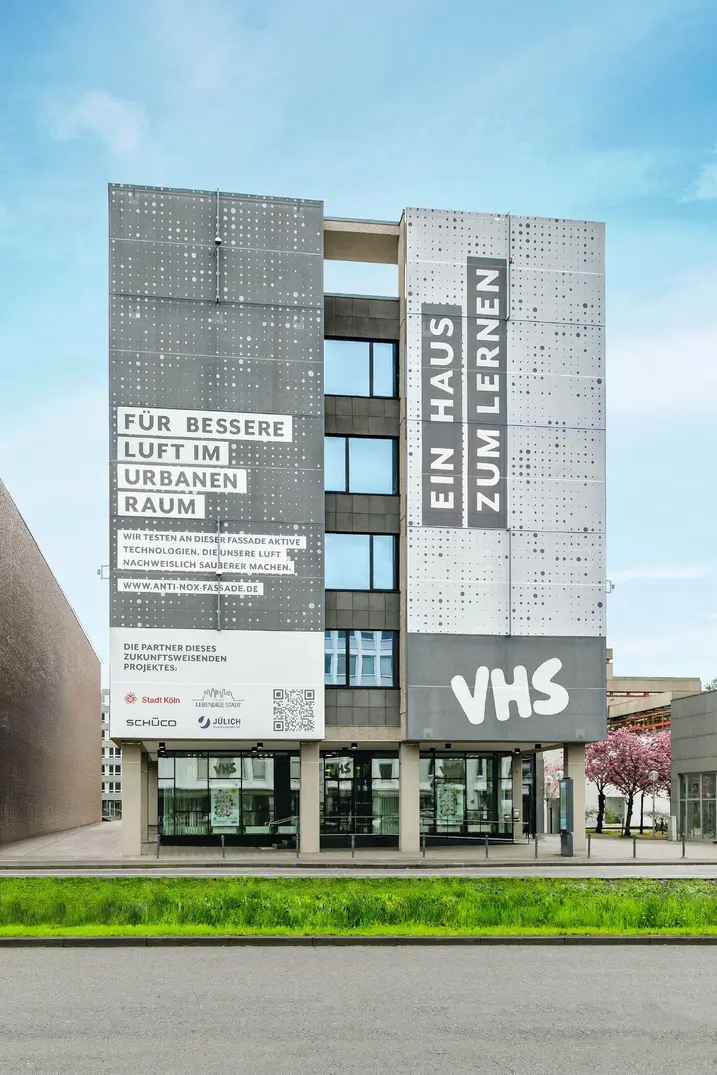
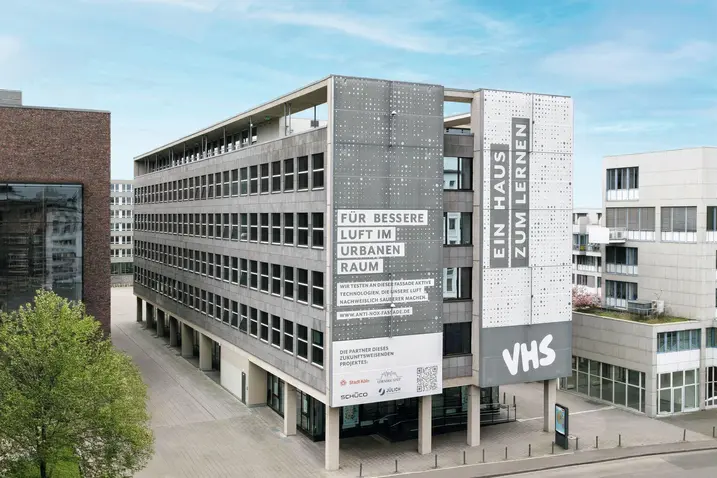
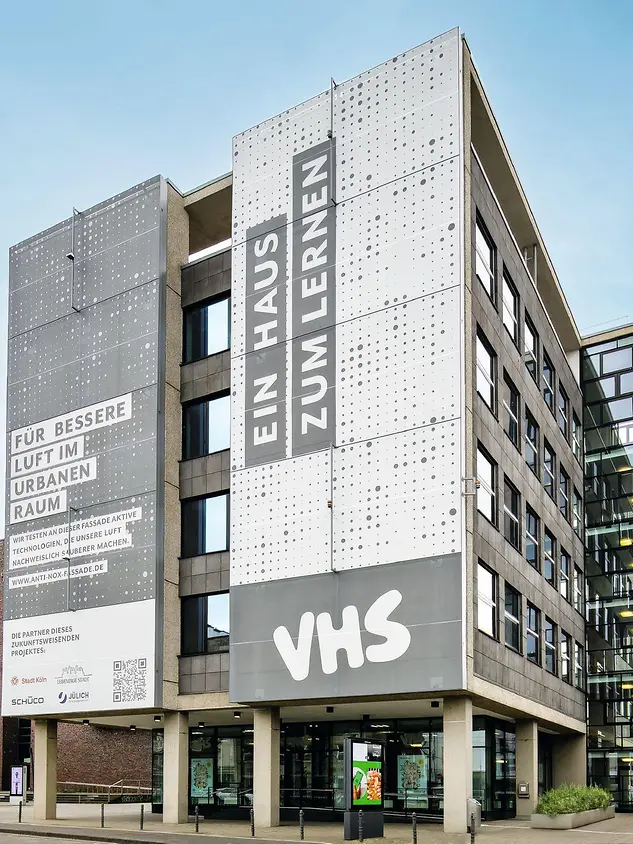
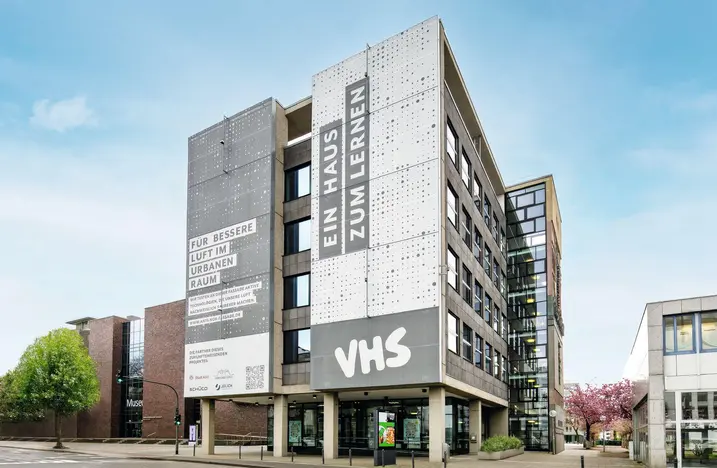
As part of a research project carried out by the city of Cologne, the “Lebendige Stadt” Foundation and Schüco, a photovoltaic textile façade was installed at the adult education centre in Cologne's Cäcilienstraße. The measurements show that it reduces nitrogen oxide pollution in the air by approx. 30%. The project is intended to serve as a model for other cities.
Details zur Referenz

Gebäudetyp Forschung und Bildung
Produktbereiche Fassaden
Schüco Systeme FACID AC
Standort Köln, Deutschland
Fertigstellung 2024
Architekten Jan Serode
Fachbetrieb Hillebrandt GmbH
Bildnachweis © Fotografie Ulrik Eichentopf

New membrane cleans the city air

The project to clean nitrogen oxide-polluted air in inner city Cologne began in 2024. For this, a textile façade that binds nitrogen oxides was installed on the adult education centre building in Cologne's Cäcilienstraße. The membrane uses special active agents to filter out the nitrogen oxides that are harmful to our health and the environment, and converts them into harmless minerals. The photovoltaic filter consists of two printed membrane surfaces, each measuring 8 x 20 metres. Digital technology measures the air quality in front of and behind the membrane in order to evaluate and document the filter performance.

Filter performance continually improves

The measurements taken on the nitrogen oxide-binding membrane show that, based on average monthly values, filter performance of around 30% is achieved. Individual measurements taken daily are even higher. For the shadier, north-facing orientation of the education centre building, this is an impressive value. The project also demonstrated that filter performance increases with increasing exposure to daylight and high temperatures. Since January 2025, the filter performance has continually improved. This positive trend has so far continued unbroken. With the membrane positioned in a south-facing orientation, it can be assumed that, under otherwise identical environmental conditions, the light intensity would be up to three times higher and therefore filter performance would be considerably better than on a north-facing façade.

Anpassung an den Klimawandel

Die Membran hat einen Kühleffekt auf das Gebäudeinnere, da sie die Gebäudefassade vor unmittelbarer Sonneneinstrahlung und damit das Innere vor Erhitzung schützt. Dadurch sinkt der Energiebedarf für die Kühlung, was CO₂-Emissionen reduziert. Gleichzeitig strahlt die Membran weniger Hitze in den urbanen Raum ab, so dass auch hier ein Kühleffekt eintritt. Das ist ein wichtiger Baustein für Klimaanpassungsstrategien. 

Hergestellt aus wiederverwerteten Materialien

Die Textilfassade ist aus wiederverwerteten Materialien hergestellt: Für ihre Produktion wurden über 4.400 recycelte PET-Flaschen und für die Unterkonstruktion Aluminium mit einem Recyclinganteil von 75 Prozent verwendet. Auf den Einsatz von Klebstoffen wurde verzichtet. Damit kann die Textilfassade später dem Recyclingprozess zugeführt werden.